HaulTools adds connected driving and company-management systems to American Truck Simulator: a logbook, inspections, walk-around trailer service, CB conversations, dispatch, multi-stop deliveries, employees, maintenance and finances. This guide covers HaulTools for the supported Windows x64 ATS 1.61.1.1 build.
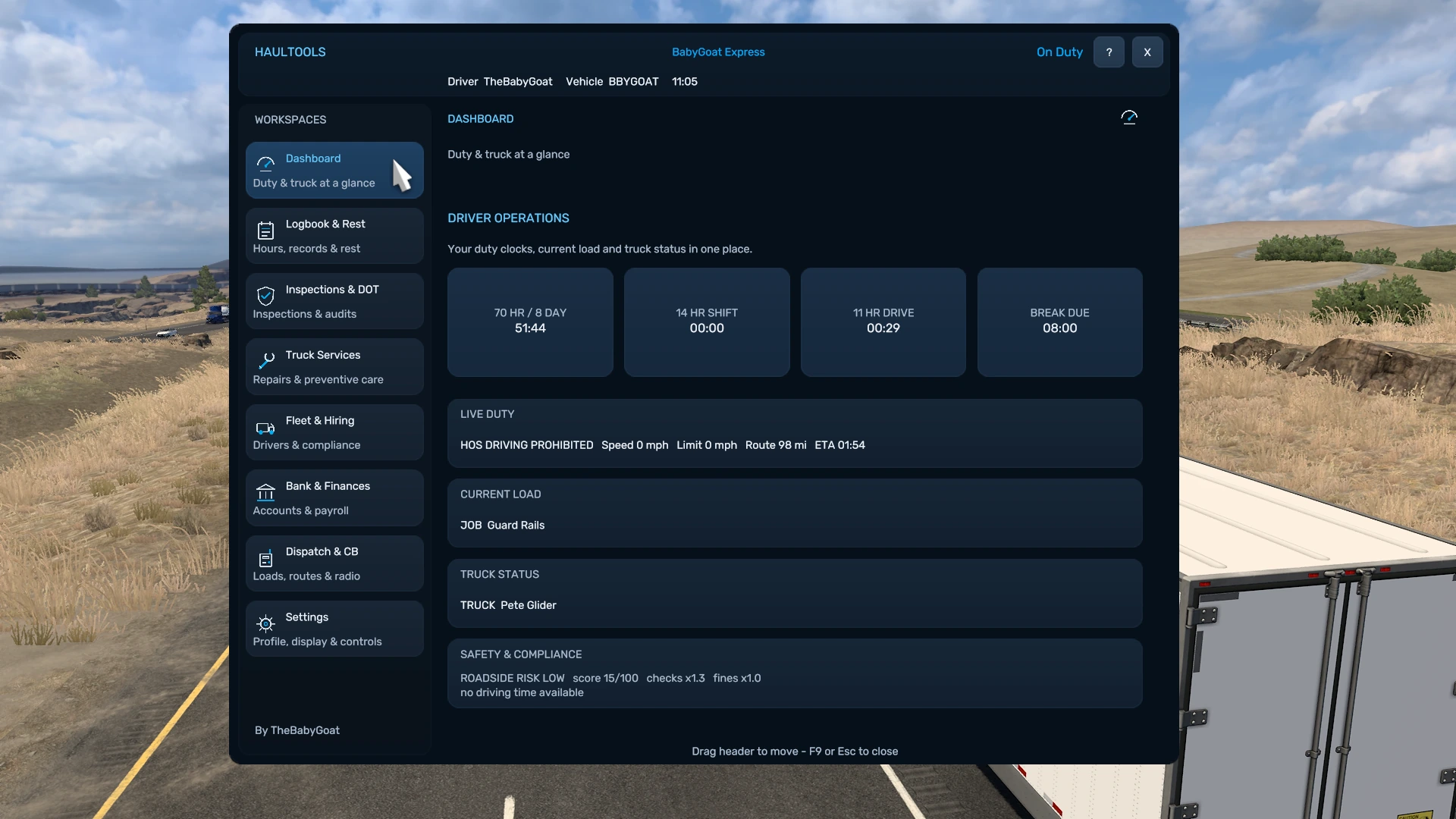
Dashboard overview: driver status, current job, duty status and current truck information.
How the parts fit together
HaulTools.dll runs the plugin and supported native integrations. ATS telemetry supplies the live truck, time and job information.
HaulTools_Tools.scs supplies the matching in-game interface. The runtime folder contains the separate CB audio pack and release defaults.
Company records and preferences persist separately from the installed DLL. Feature switches let you choose how much simulation you use.
02
Install the mod
Install the DLL, runtime folder and matching SCS together.
Close ATS first. Use the complete compiled HaulTools release for your supported game build. A source-code ZIP is for development; an update-only package assumes the full runtime/audio is already installed. The installer checks the actual game executable, so a VR or hotfix executable with the same visible version may still be incompatible.
Option A · HaulTools installer
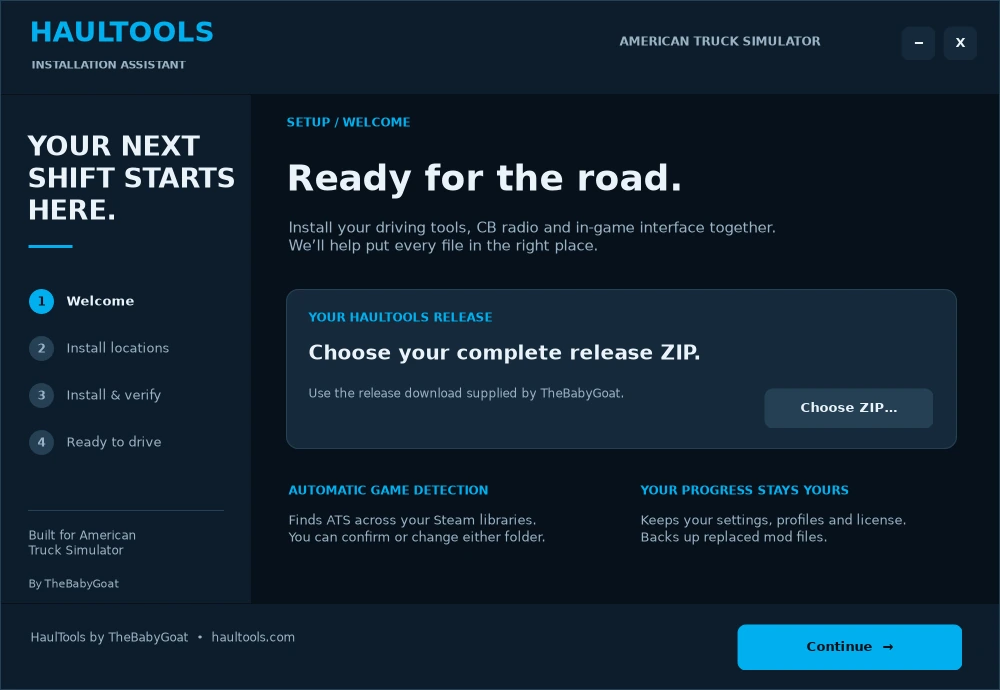
Run the supplied setup EXE. The standalone edition asks for the complete release ZIP; an embedded edition already contains it.
Review the detected ATS game folder and ATS user folder. Confirm OneDrive Documents or a custom -homedir if you use one.
Choose Install HaulTools and complete the Windows administrator prompt. Setup validates files and backs up replaced mod files.
Start ATS, enable HaulTools v2.0 in Mod Manager for your profile, apply the changes and load the truck.
Standalone installer reference. The single-file embedded edition does not need a separate ZIP selection.
Option B · Manual installation
Release item
Destination
HaulTools.dll
<ATS>\bin\win_x64\plugins\HaulTools.dll
HaulTools/
<ATS>\bin\win_x64\plugins\HaulTools\
HaulTools_Tools.scs
<ATS user folder>\mod\HaulTools_Tools.scs
Find the game folder through Steam’s local-file browsing command. The usual ATS user folder is Documents\American Truck Simulator; it may be redirected. Copy the contents of the release’s install-shaped folders into the actual destinations. The real game subfolder is win_x64. Avoid an extra nested HaulTools\HaulTools folder. Enable the SCS and remove older duplicate HaulTools UI packages from the active mod set.
03
First launch & activation
Get into the truck, activate, then choose your preferences.
Load your ATS profile and wait until the truck world is ready. Press F9 to open HaulTools.
If activation is required, choose SIGN IN WITH PATREON and follow the browser flow using the account with your HaulTools access. Return to the game and check the status. Keep the PC online during activation.
Complete the first-run setup if shown. Set your driver/company details and review duty status, hours cycle, audio devices and Settings > Simulation.
Before a normal shift, complete a pre-trip, confirm the trailer service is finished, check the active route and review due company tasks.
04
Controls & workspaces
Defaults shown here; your saved bindings take priority.
Action
Default
Main interface / close
F9 · Esc
Exit / enter cab
F12
Walk / run / headlamp
W A S D / ↑ ↓ ← → · Shift · Ctrl + F12
CB push-to-talk / replies
F10 · Alt + 1 / 2 / 3
CB power
Ctrl + Shift + R
CB / logbook / dispatch windows
Ctrl + Shift + C / L / D
Small-window interaction
Ctrl + Shift + M
Off duty / sleeper / driving / on duty / break
1 / 2 / 3 / 4 / 5
Trailer actions use your ATS Trailer attach/detach keyboard binding, normally T. Walk inspections use the detected ATS activation binding, with E as fallback; the on-screen prompt is authoritative. Change supported HaulTools bindings in Settings > Hotkeys. F12 and reserved combinations are not interchangeable with normal menu hotkeys.
The main workspaces are Dashboard, Logbook & Rest, Inspections & DOT, Truck Services, Fleet & Hiring, Bank & Finances, Dispatch & CB and Settings. Use the page’s ? button for contextual help. For small driving windows, enable interaction, drag them into position, then use Save UI widgets in Settings and leave interaction mode.
05
Walk mode
Work around the parked truck.
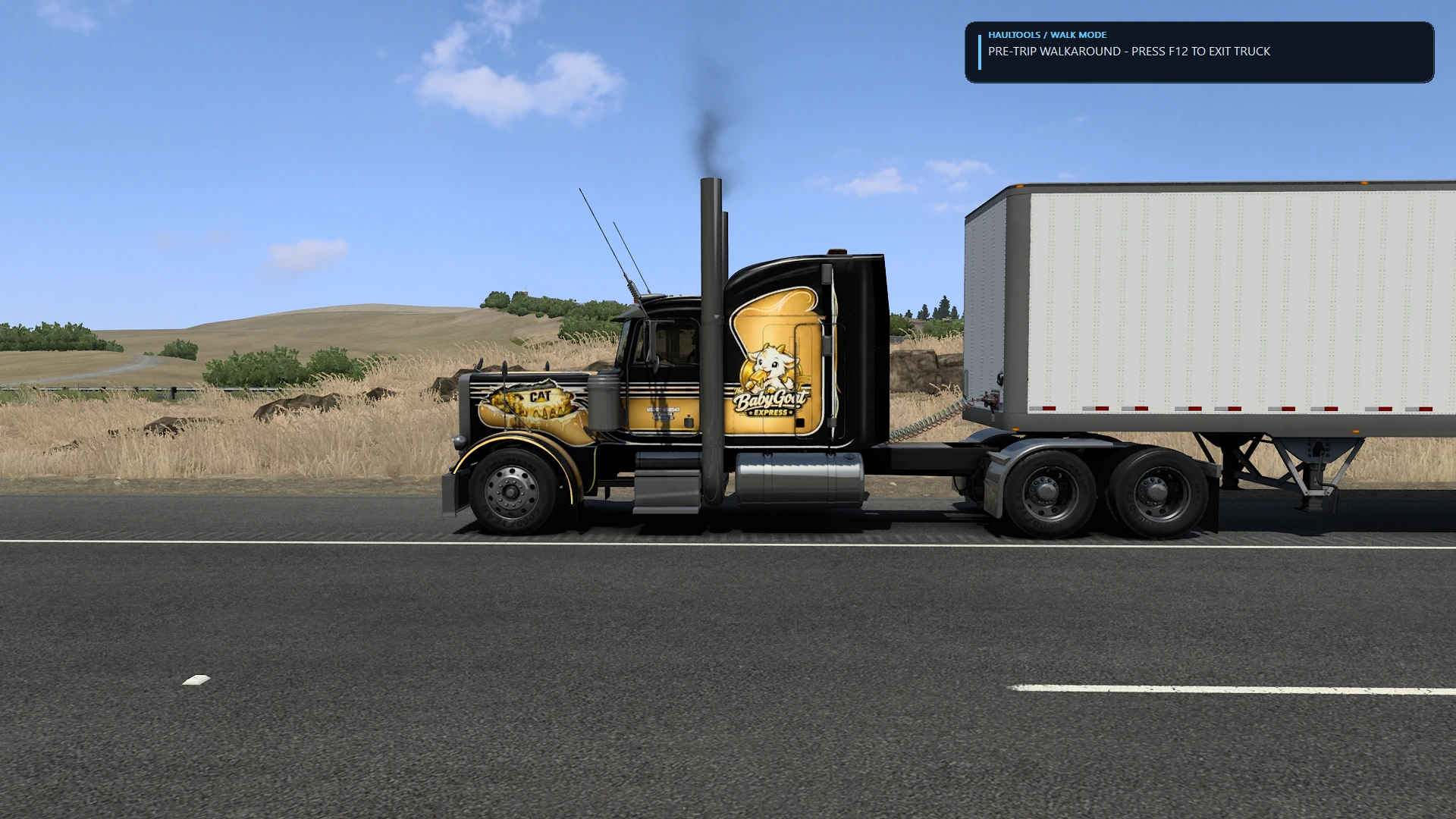
Park and secure the truck before pressing F12. Wait for the exit fade to finish. Move with WASD/arrows and look with the mouse; hold Shift to run.
The truck controls are isolated while walking. The walk contact-damage guard protects the truck, trailer and cargo from walking collisions; it is not a general driving-damage setting.
Walking and running sounds are embedded. Switch them off in Settings > Simulation if desired. Use Ctrl+F12 for the headlamp and Settings > Headlamp for beam adjustments.
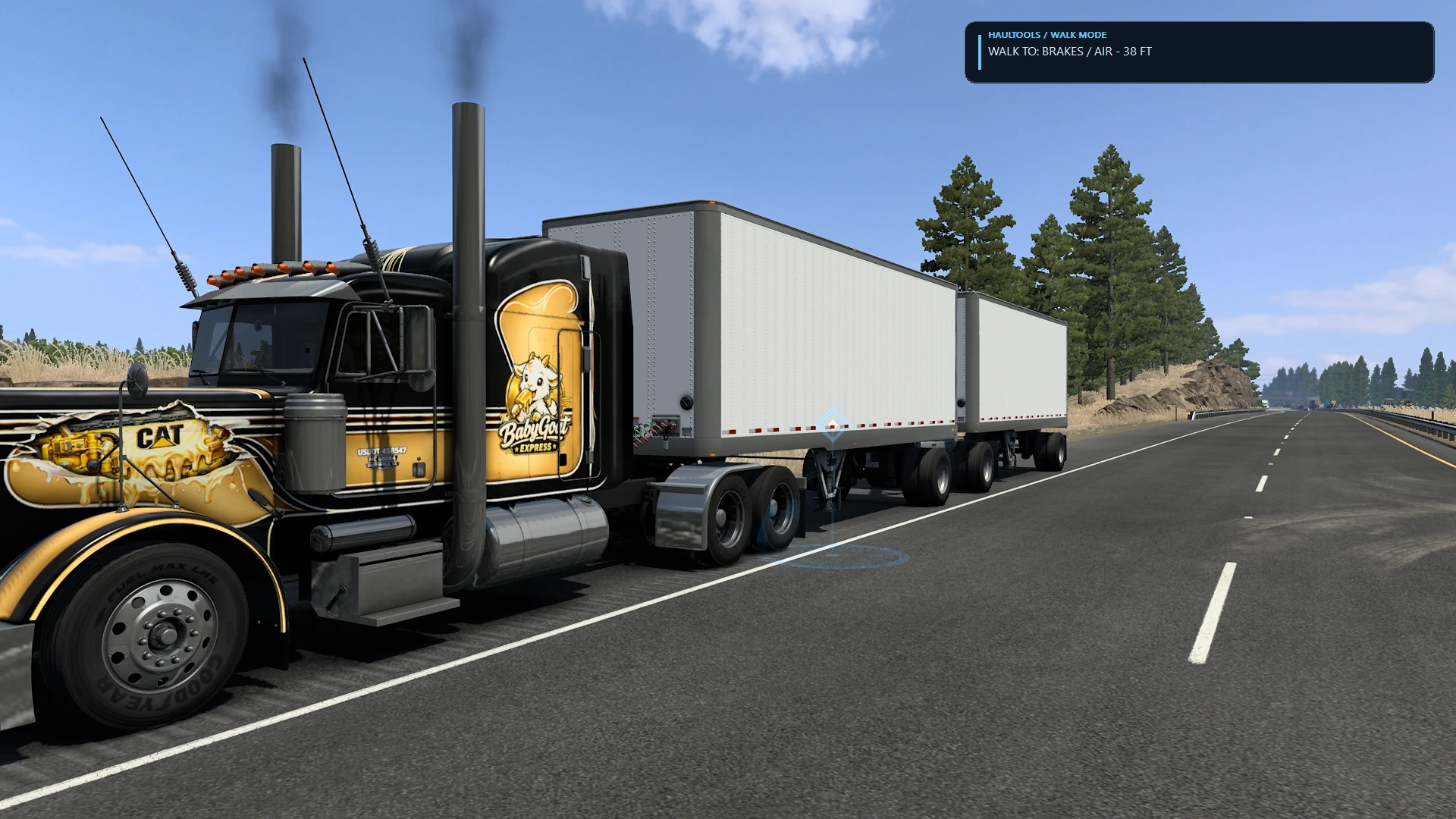
Read the notification bar for the next action. Press F12 to return to the cab. Transition fades hide the notifications until the view is ready.
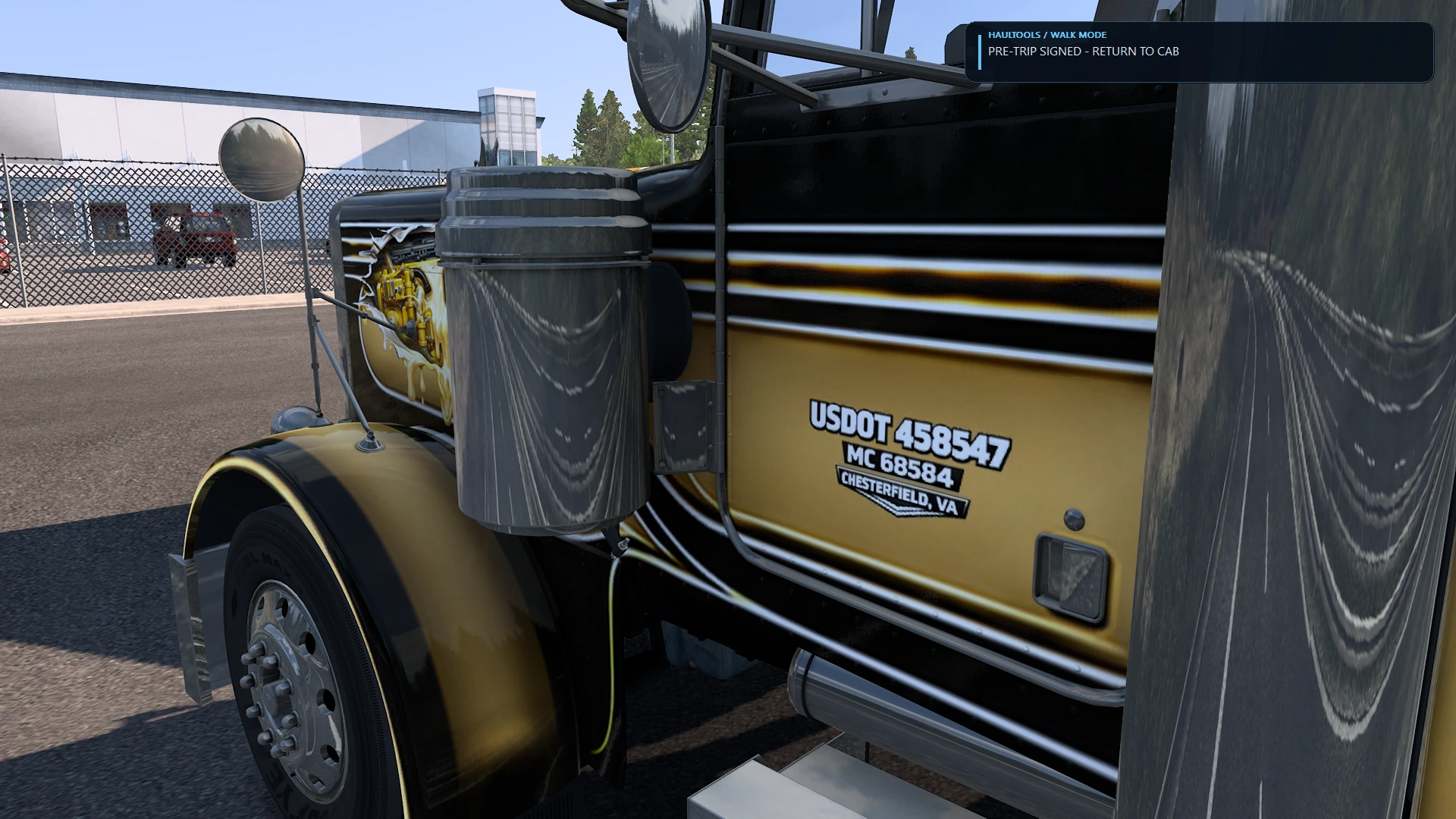
In-game reference: a completed inspection still needs a signed report. Follow the current notification at the top right.
06
Connect & disconnect trailers
Mechanical coupling first; outside service follows.
Hook up
Enable Outside trailer service in Settings > Simulation. Back into position using ATS coupling; with Advanced Coupling, align the kingpin correctly. Use the native attach key if ATS requests mechanical engagement.
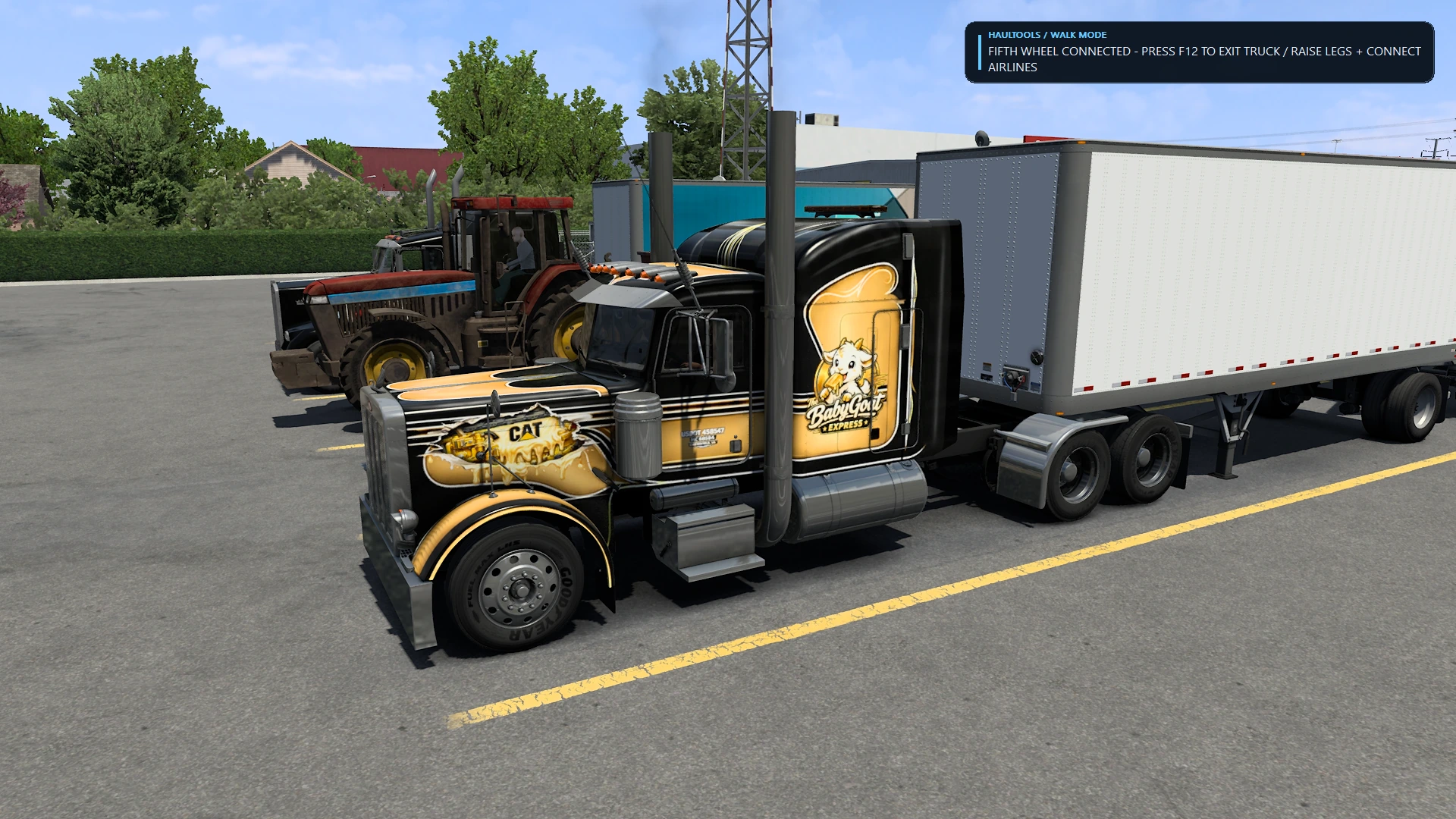
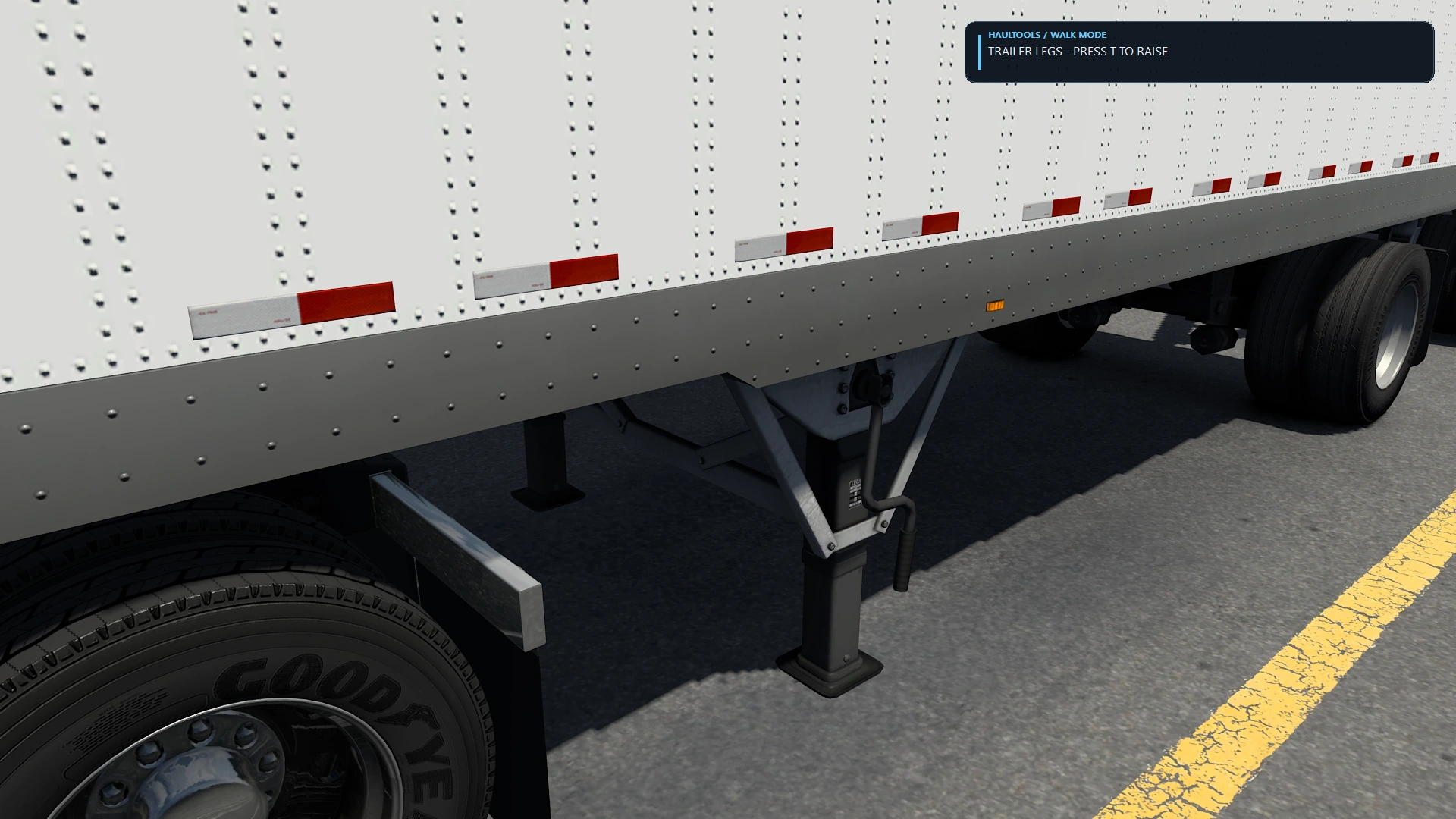
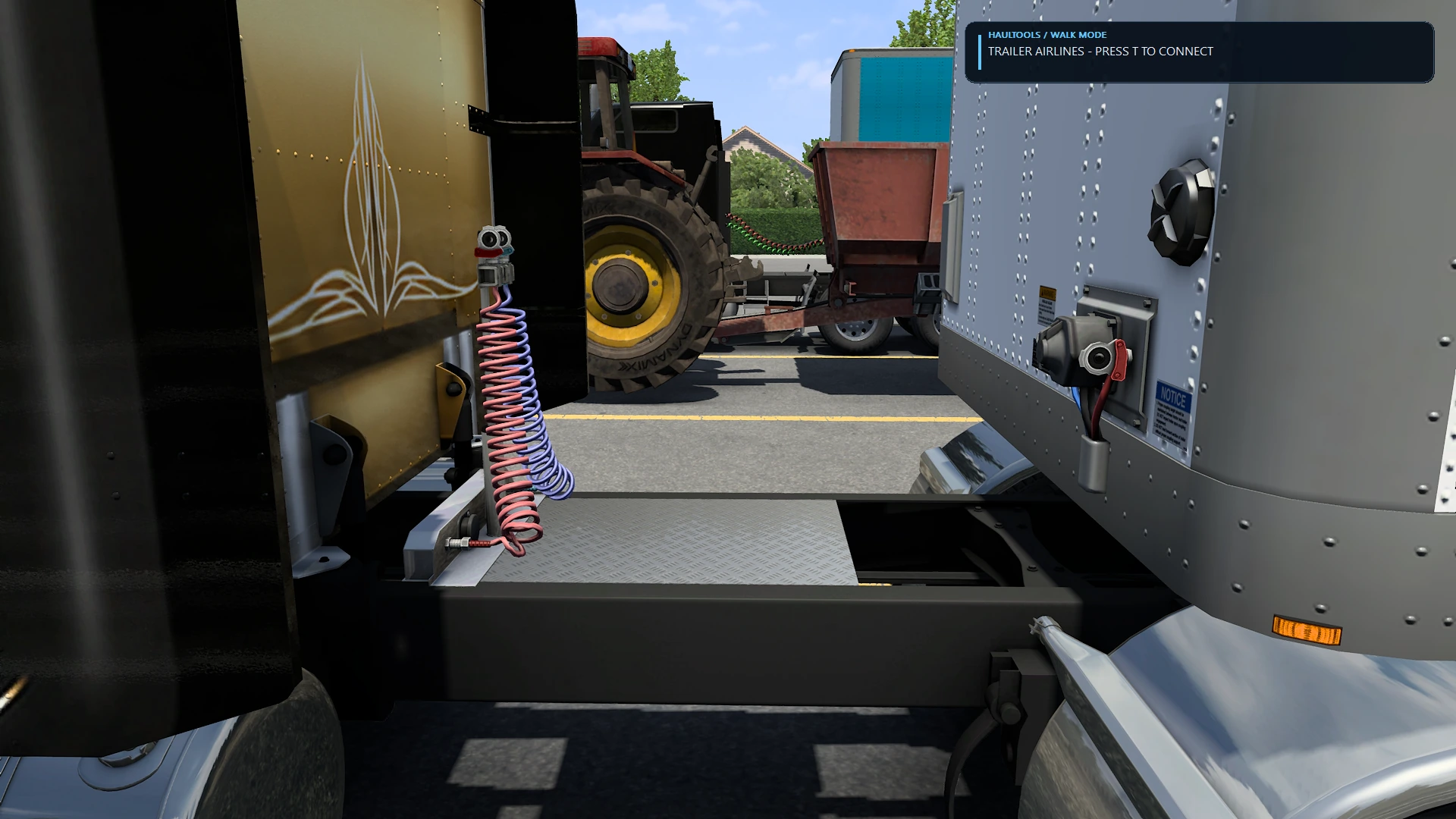
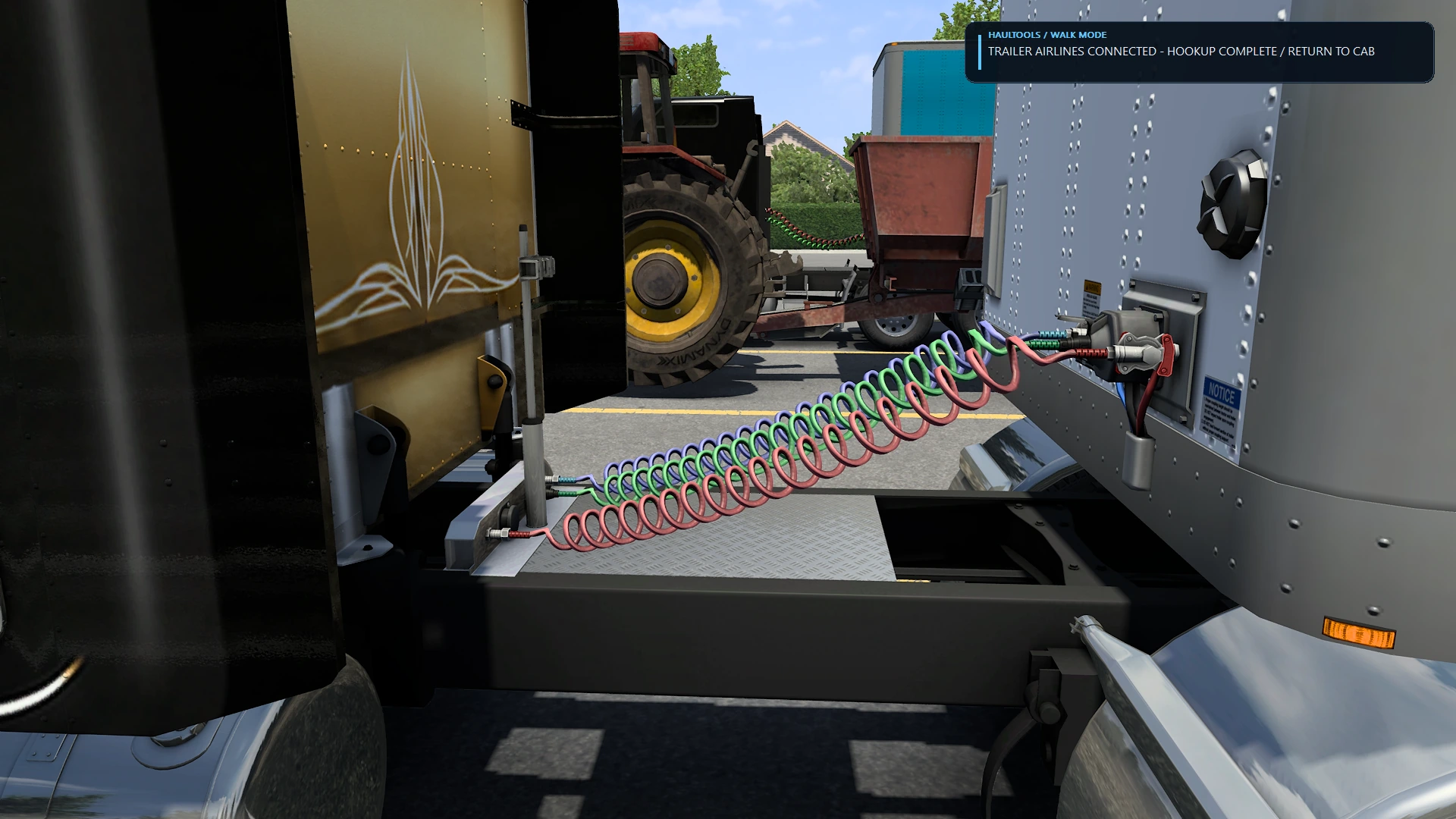
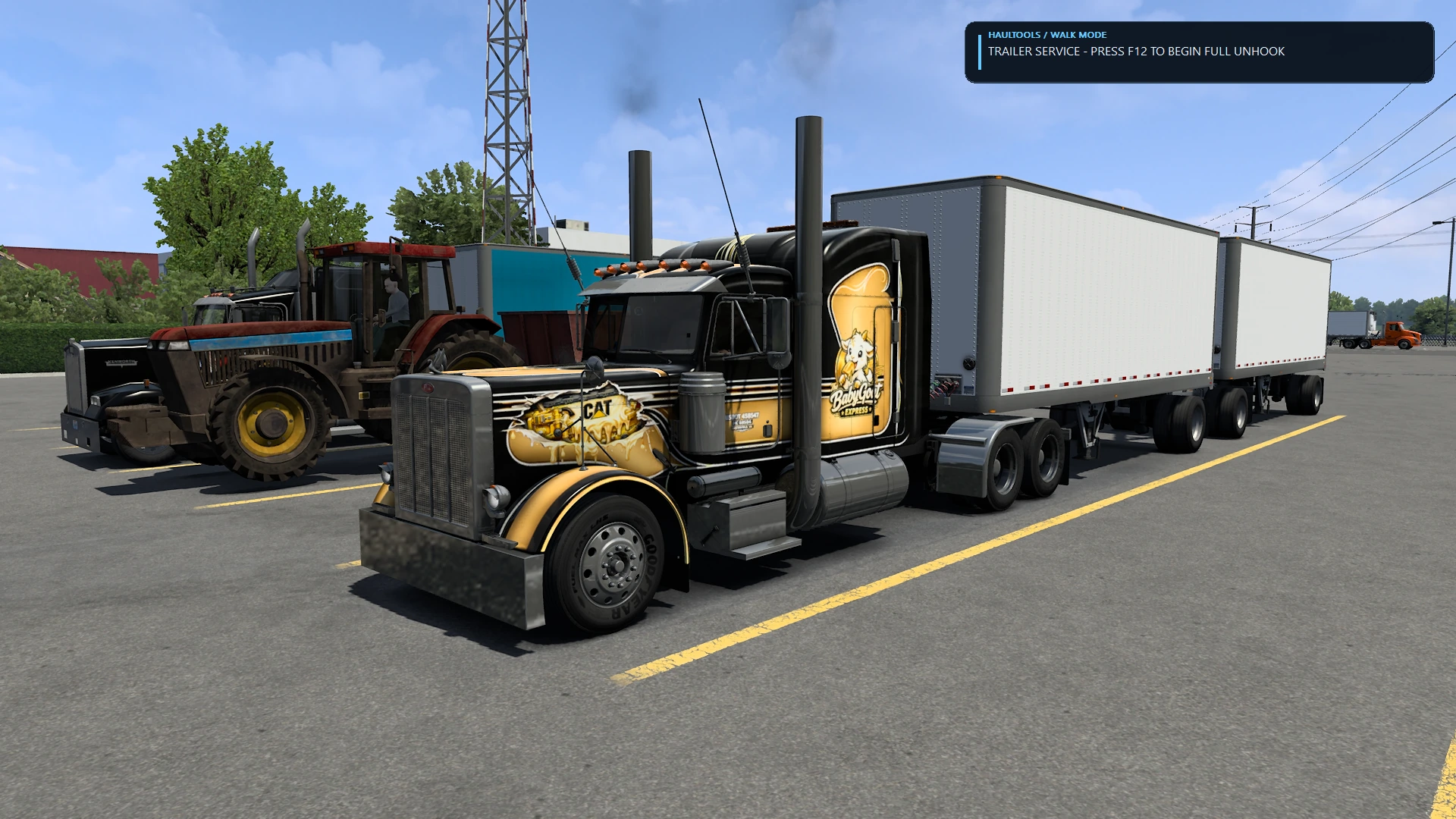
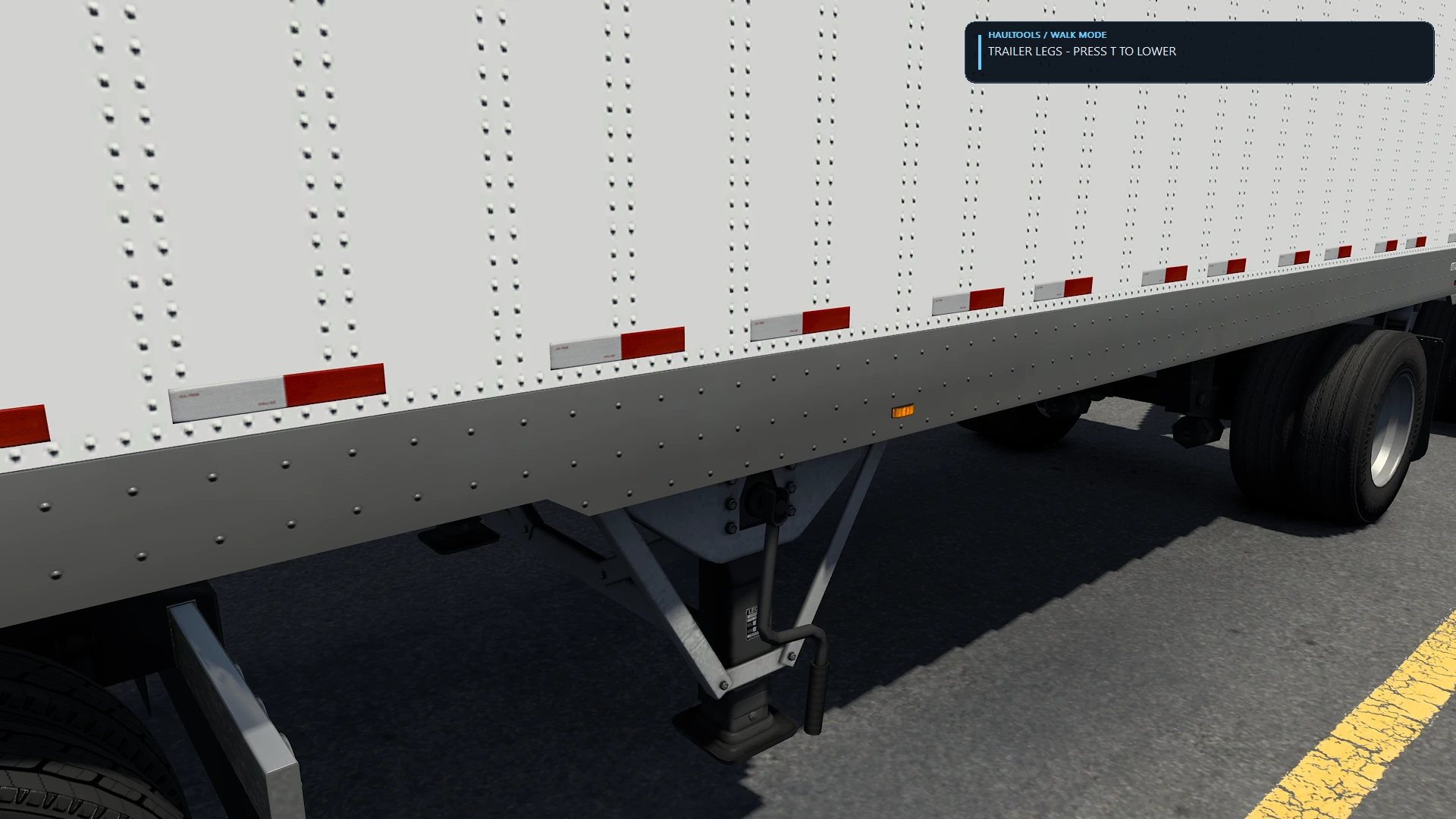
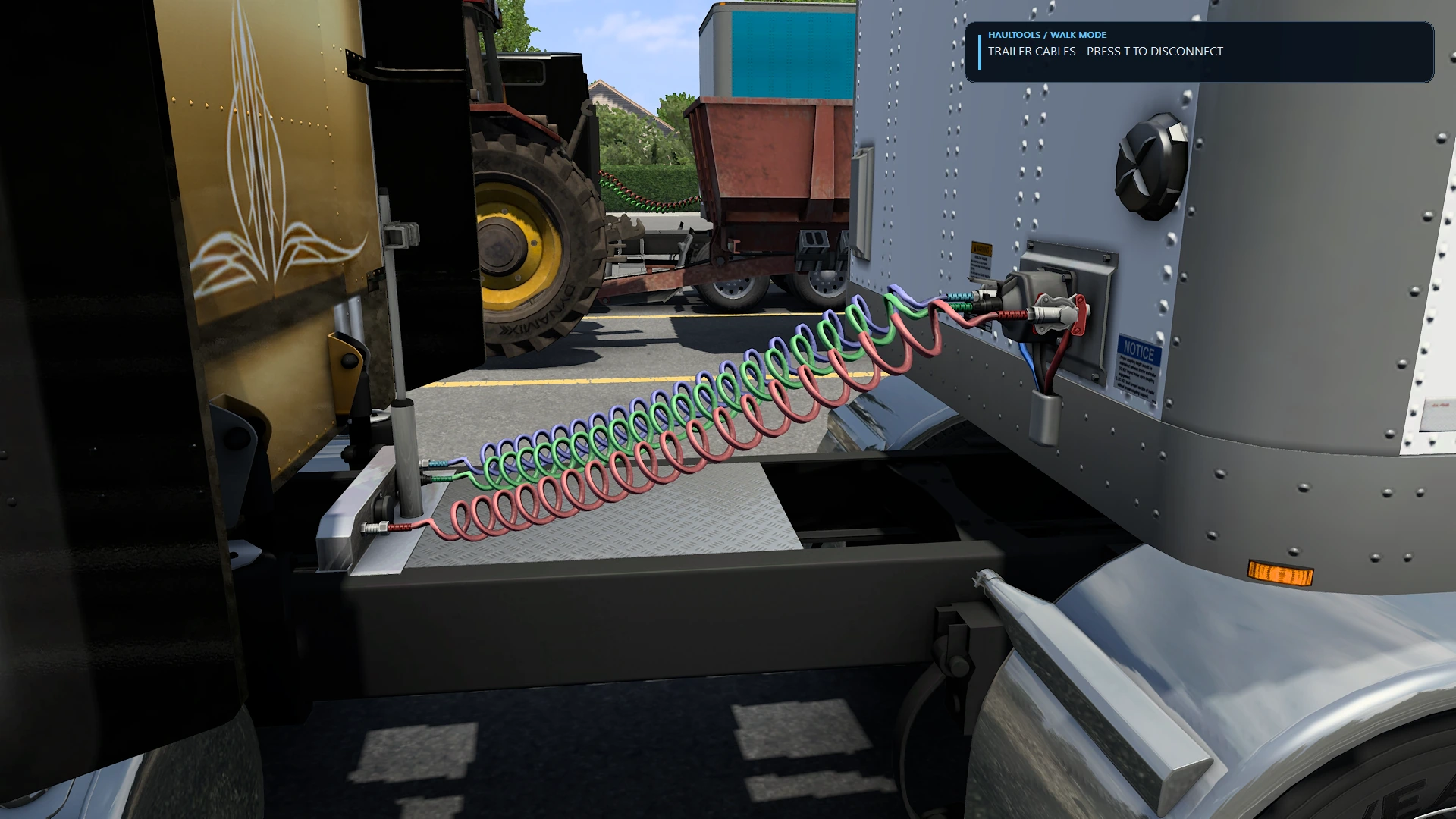
Once the fifth wheel is locked, follow the exit prompt and press F12. At the indicated stations, raise the landing legs if required, then connect the air/electrical lines with the displayed attach key.
Wait for the completed-hookup confirmation before driving. A trailer already fully coupled in a loaded save does not require a cosmetic second hookup.
After the native fifth-wheel connection, exit the cab and finish the outside hookup service.Raise the trailer legs when prompted during hookup.Reconnect the trailer airlines when prompted.Hookup completes after the airlines are connected; return to the cab.
Unhook
Initiate the detach workflow and follow the outside prompts. For trailers with legs, lower the legs, disconnect the lines and complete the fifth-wheel release-handle step. For a verified legless trailer, disconnect the lines outside, return with F12 and use ATS’s native unhook command when prompted. Disconnecting lines alone leaves the fifth wheel coupled.
Start the full outside unhook workflow with the combination parked and secured.Lower the trailer legs when prompted during unhook.Disconnect the trailer lines before completing the fifth-wheel release.
07
Pre-trip & post-trip inspections
Inspect each station, then sign at the driver door.
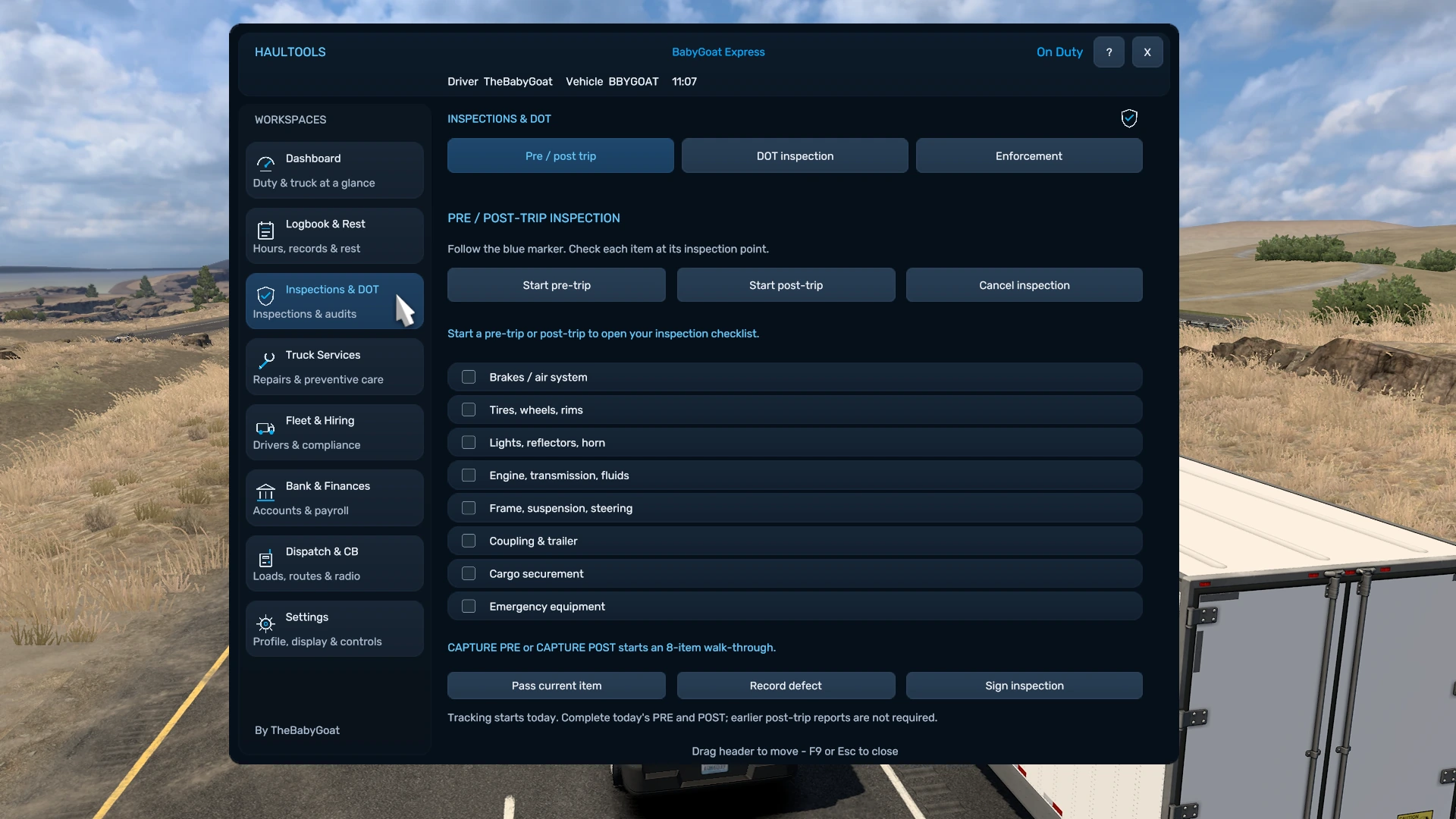
Park, open Inspections & DOT and begin the appropriate pre-trip or post-trip walkaround. Exit the cab when prompted.
Follow the current cyan marker to its truck/trailer service zone. It stays anchored to the vehicle station and is visible from a distance. Move close enough for the interaction prompt.
Press the displayed inspection key to mark the item OK. Hold Shift with that key to record a defect. Work through every required item; do not mark a known defect as OK.
Return to the driver-door marker and use the displayed key to sign. Wait for PRE-TRIP SIGNED or POST-TRIP SIGNED. Starting or completing the checklist without signing is not a signed report.
Inspections & DOT: start pre-trip/post-trip walkarounds and review DOT inspection tools.Walkaround inspection: follow the active station prompt around the truck.The walkaround continues around the full truck/trailer combination as each station is completed.
The logbook tracks inspection records and can be audited at a DOT check. Finish your post-trip at the end of the game day. Switching Walk inspections off leaves desk inspection records available. Markers represent service zones, not exact model sockets; unusual modded chassis or sharply angled trailers can place a zone differently from the visible component.
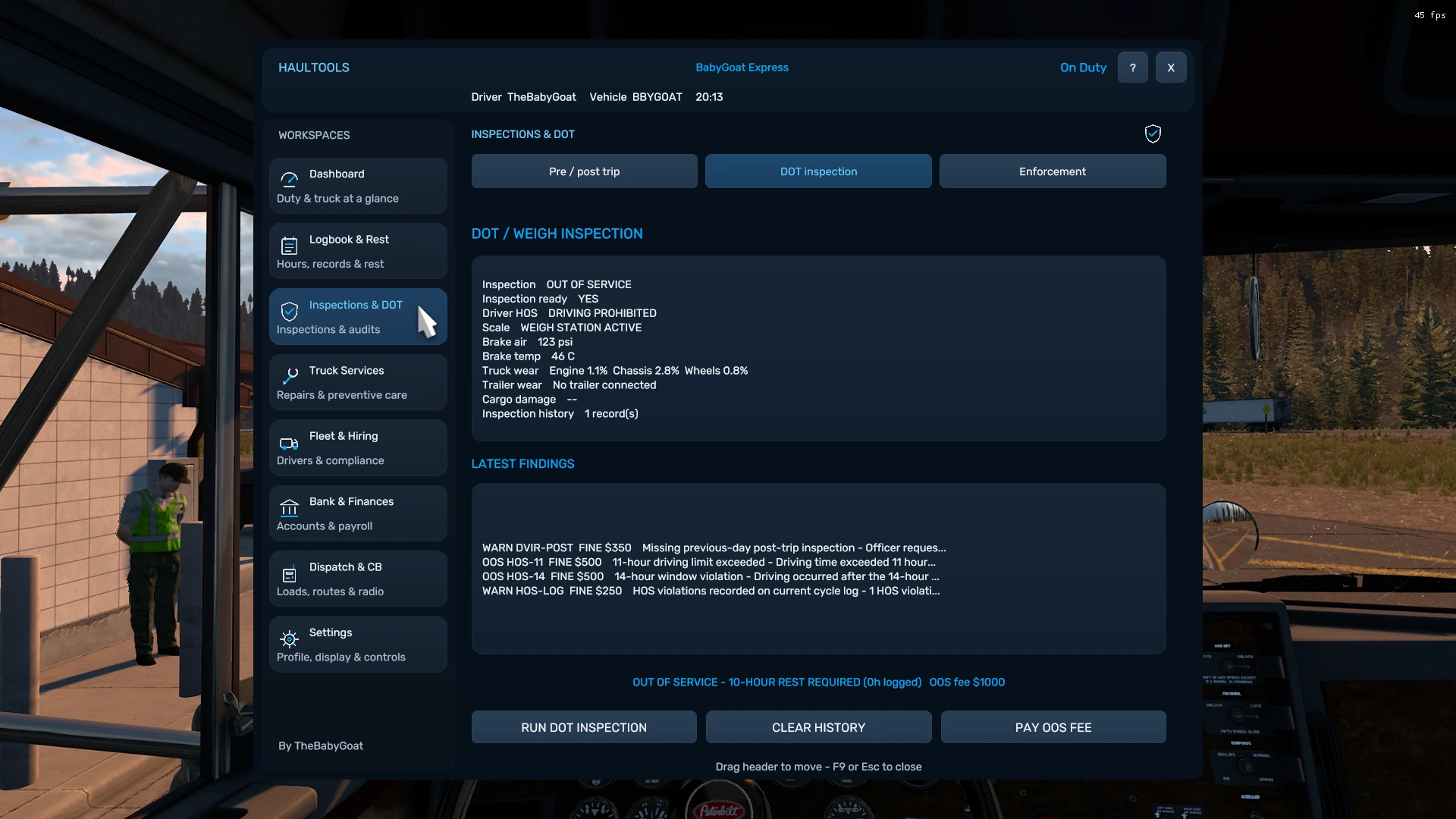
DOT / Weigh Inspection: review current status, latest findings, out-of-service restrictions and required fees or rest.
08
Logbook, rest & DOT
Use ATS game time to manage the working day.
Choose the appropriate duty state in Logbook & Rest. Automatic duty changes can mark driving when enabled; review your status when parked. The simulation tracks an 11-hour driving allowance, a 14-hour shift window, a break after eight cumulative driving hours and a selectable 60/7 or 70/8 duty cycle. These are HaulTools gameplay systems.
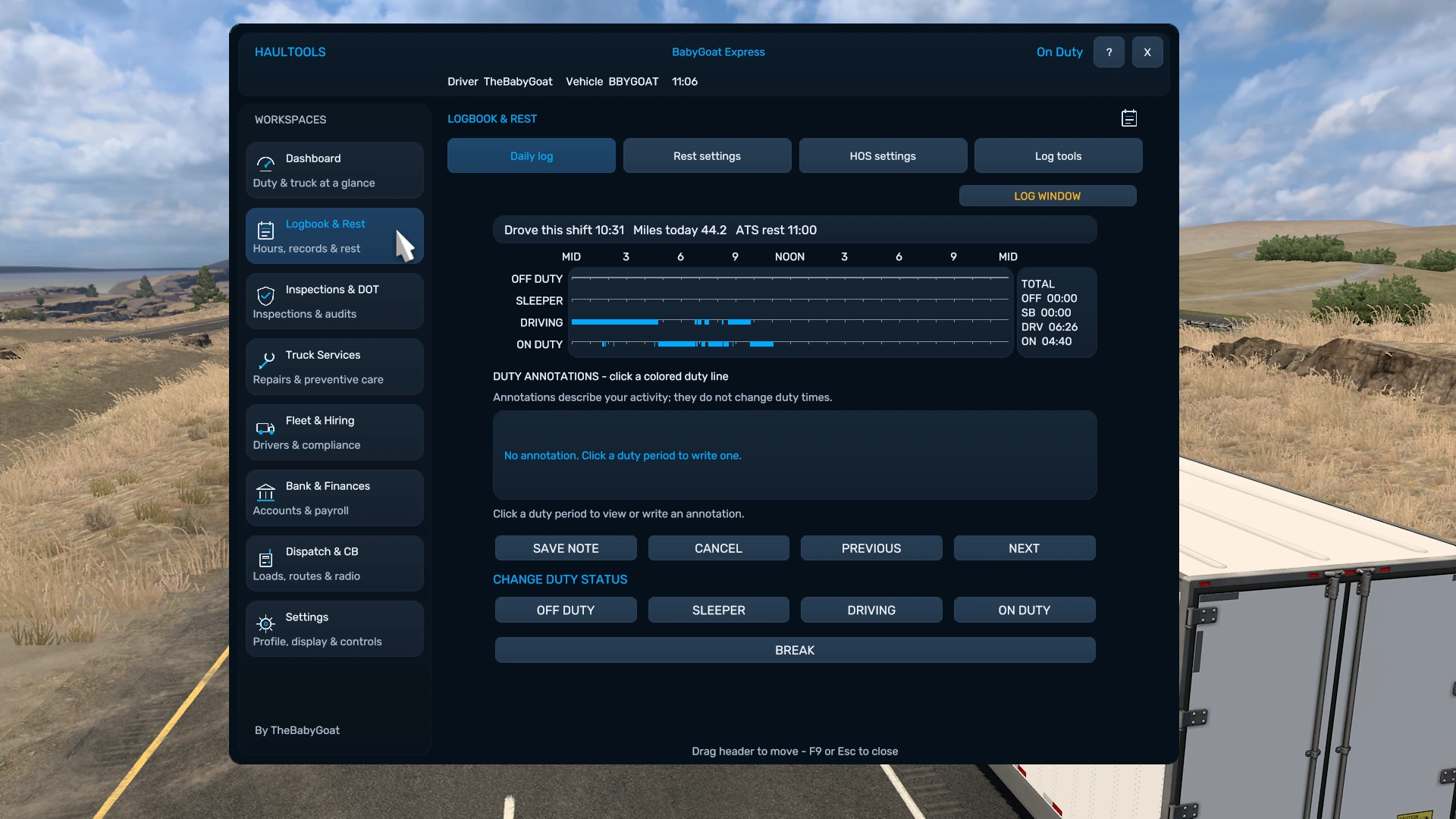
Logbook & Rest: HOS clocks, annotations, log entries and duty-status controls.
Rest
In-game effect
30 minutes without driving
Qualifies for the break counter; it is not a full daily reset.
10 continuous hours off duty / sleeper
Resets the daily drive/shift counters.
34 continuous hours of qualifying rest
Resets the cycle.
In supported single-player play, Sleep Anywhere can advance time while stopped; the default sleeper rest is 600 game minutes. Fast Break can advance 30 game minutes. Wait for confirmation after the animation or fade. In Convoy these actions select duty only and ordinary game time must pass; they do not skip the shared clock.
DOT checks and records
A native weigh-station stop can trigger a HaulTools logbook, inspection or combined check when random checks are enabled. Read the findings, required rest/service and any out-of-service restriction before continuing. Paying a charge does not itself complete an unfinished inspection or repair. Export CSV from logbook tools when needed. RESET HOS and CLEAR LOGBOOK are different actions; clearing history is not a way to renew the first-day inspection exemption.
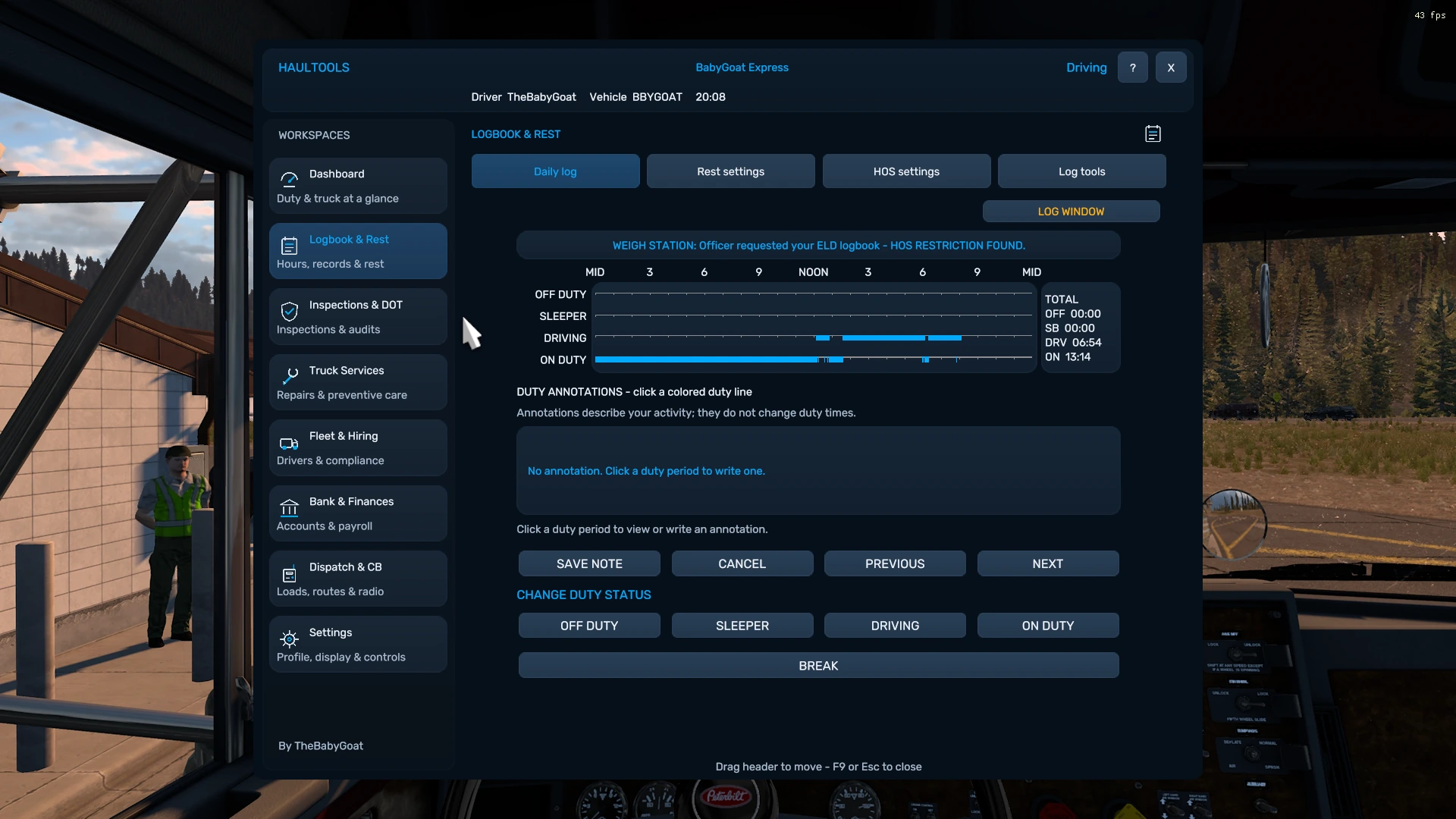
Weigh-station enforcement can request the ELD logbook and flag an HOS restriction while the officer is active.
09
CB radio & voice
Choose the right microphone and learn one command at a time.
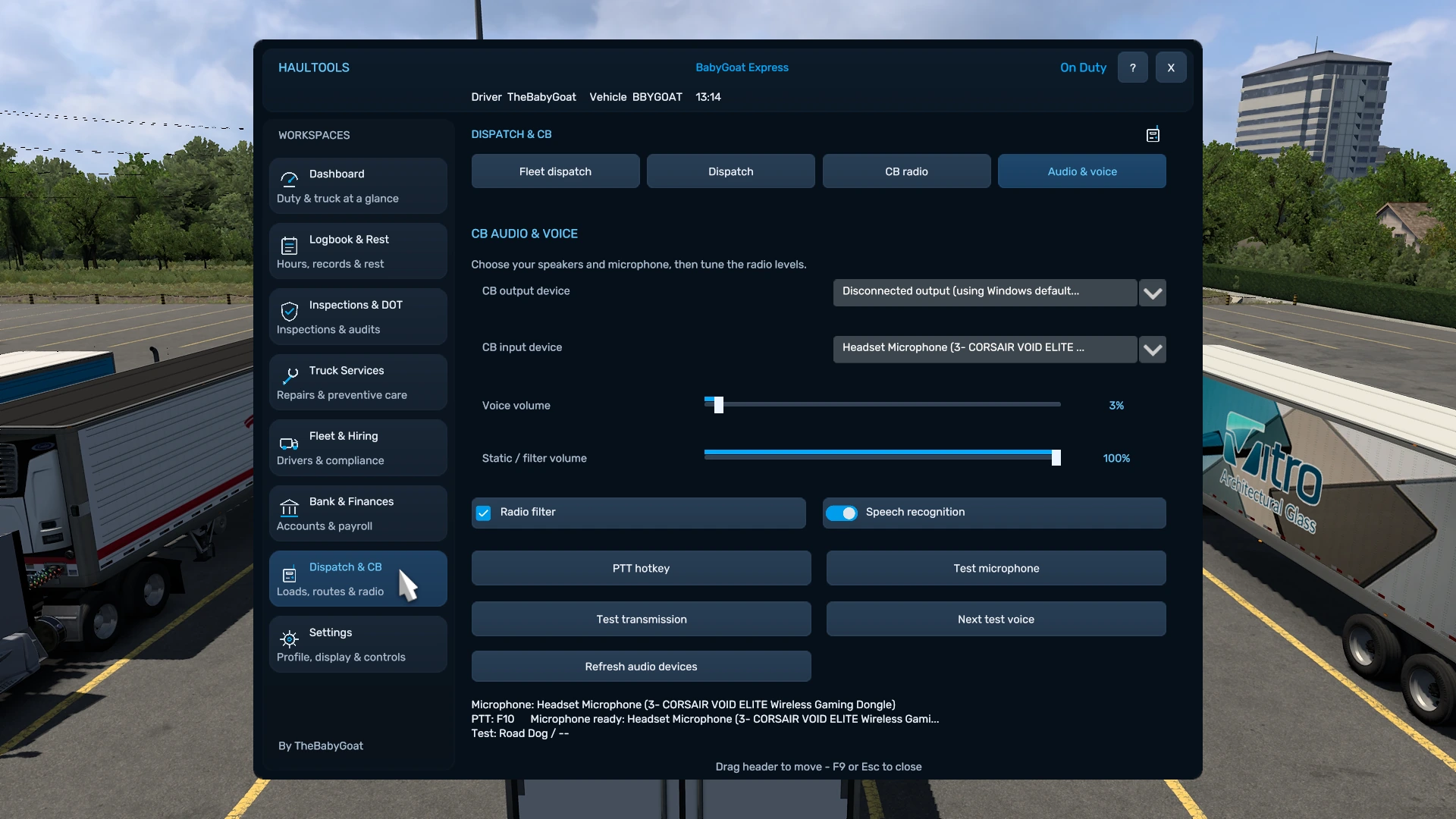
Open Dispatch & CB > Audio & voice and select the intended input/output devices. Check Windows microphone permission and the recording level.
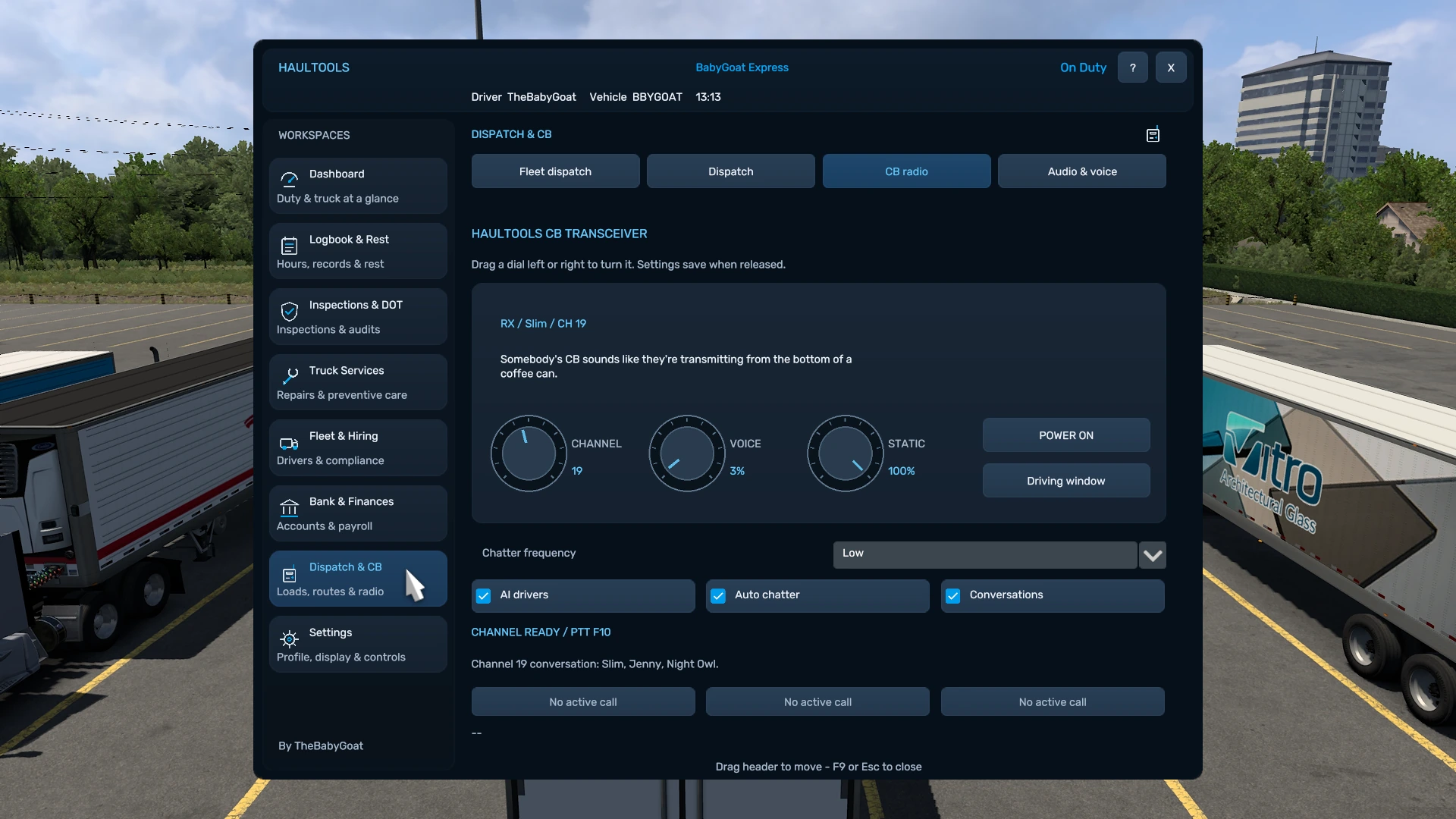
Turn on CB radio. New defaults are 10% voice and 30% static/filter volume; these are independent controls. Adjust chatter frequency, AI drivers and conversations to taste.
Hold your PTT binding, say one complete phrase, then release it and wait for the response. Use the displayed reply buttons or Alt+1/2/3 when a conversation offers replies.
Audio & Voice: select devices, adjust levels and test speech recognition.CB Radio: power, channel, voice/static levels and chatter controls.
Try saying
Purpose
radio check
Test recognition and a response.
dispatch find me a load
Search nearby freight offers.
dispatch find me a multi-stop load
Request an eligible multi-stop route.
dispatch accept load
Accept the current available offer.
The supplied voice commands and custom phrase format are English. This guide’s Spanish/German translations do not add Spanish/German recognition or recordings. Custom phrases live in the active configuration’s CB_SpeechPhrases.txt; preserve the command IDs and format and restart ATS after editing. CB chatter is simulated/prerecorded communication, not voice chat with other Convoy players.
10
Dispatch & multi-stop loads
Follow the HaulTools stop card through the entire delivery.
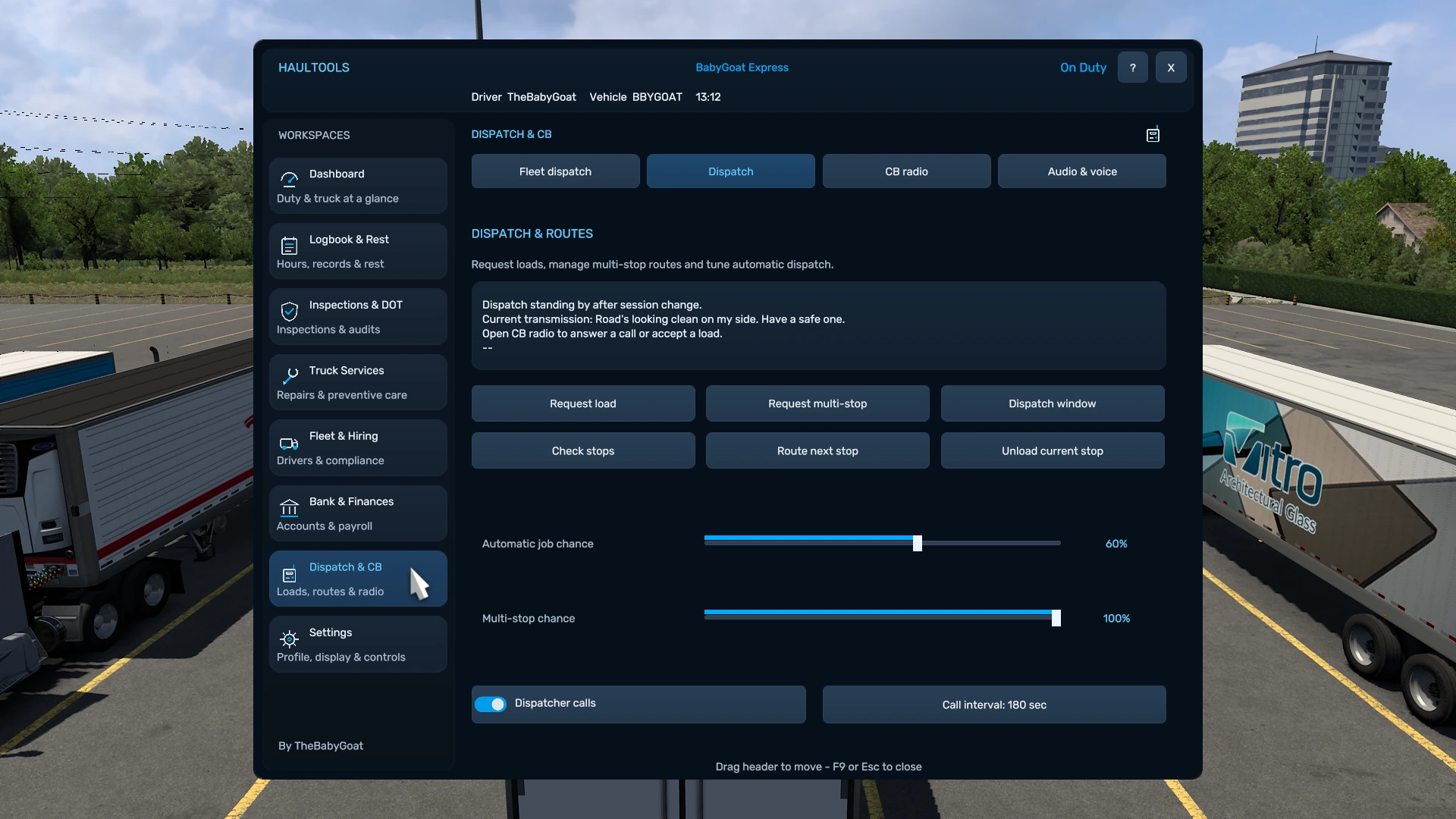
Use Dispatch & CB to review player job offers and the separate dispatch window. The ordinary player-job dispatch switch is off in the supplied defaults; explicit multi-stop requests have their own path. Request while parked and wait for planning to finish. A request still needs valid depots, road connections, cargo capacity and skills; it does not guarantee an offer.
Dispatch: freight requests, multi-stop requests, dispatch window and automatic-offer controls.
Tankers, lowboys, dumpers, silos, livestock, car carriers, machinery-loaded flatbeds and unknown bodies.
Doubles qualify only when every loaded trailer body is eligible; empty dollies are ignored. Existing saved multi-stop contracts remain finishable. Current new-plan defaults are 3–6 delivery stops and a maximum 300-mile total delivery route; travel to pickup is separate.
Accept the offer and collect the load. Verify the current stop on the HaulTools card and the GPS destination before leaving.
At a receiver, park within 650 ft (198.12 m) of its recognized delivery/company point, on the required level. Keep the trailer attached, apply the parking brake and remain stopped for two seconds.
Choose UNLOAD STOP and remain parked through the ten-second countdown. Wait for cargo/payment confirmation and the next GPS update. Intermediate stops pay $1,500 by default; the final delivery uses ATS’s normal contract settlement.
Use the card’s unload/final-delivery workflow at the last receiver and confirm completion. Do not assume the native contract panel lists every intermediate stop.
11
Fueling & Fuel Card
Use another fuel aisle within the recognized station radius.
HaulTools extends recognized fuel-only triggers to a horizontal 150 ft / 45.72 m radius. The circle is centered on the station trigger, not on the walker. You can refuel in another aisle within that radius when ATS’s normal conditions are satisfied. Stop, turn off the engine as required and use the native fuel action while following HaulTools prompts.
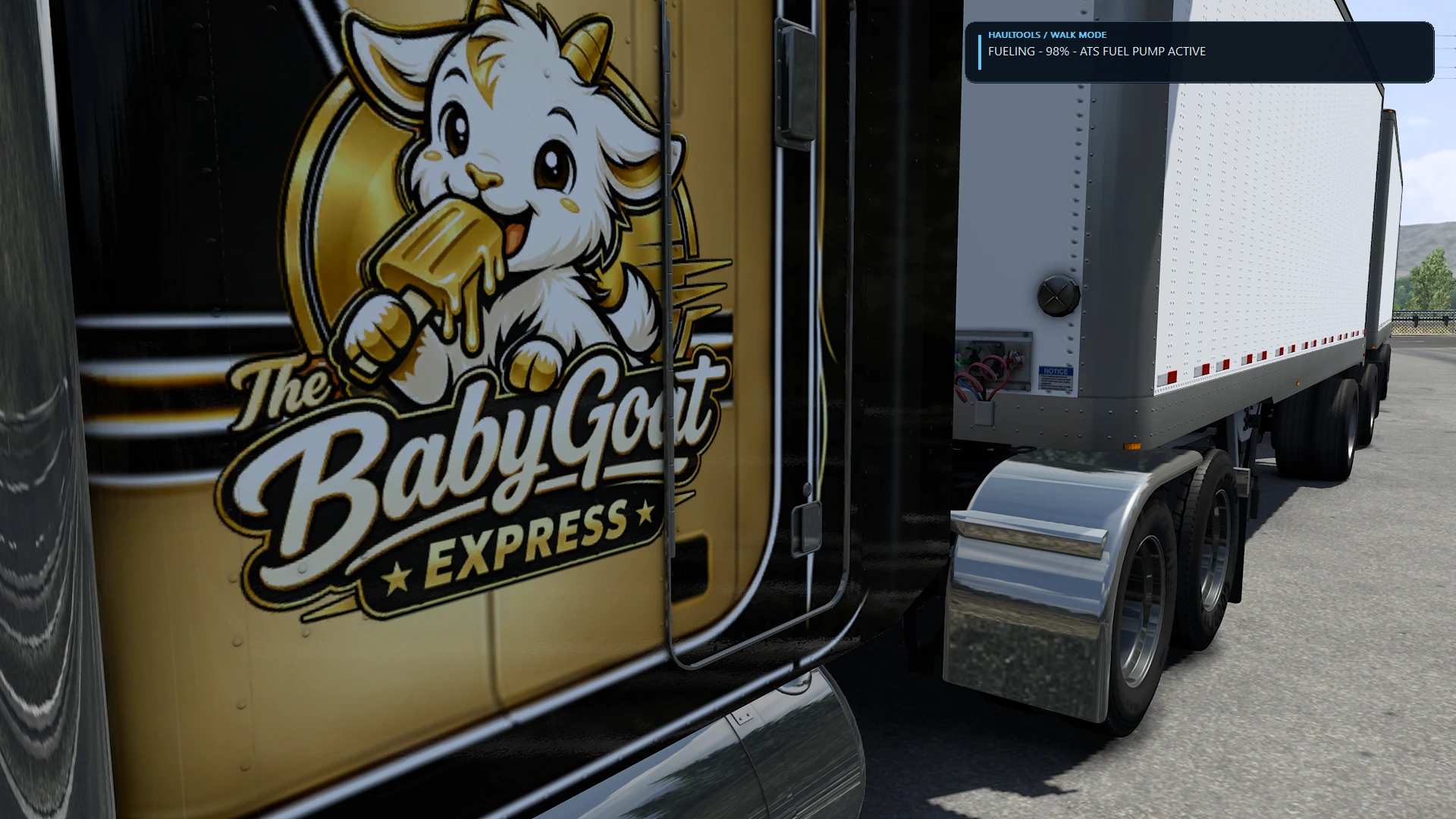
Manual refueling prompt shown while positioned in a recognized fuel zone.
The extension keeps the native height restriction. A bridge above the station is not a valid fuel point. Garages, delivery points, tolls, mixed-action and unsupported triggers retain their normal range.
ATS still controls fuel quantity, price and pump operation. The Fueling prompts switch only controls HaulTools notifications; it does not enlarge or disable the radius.
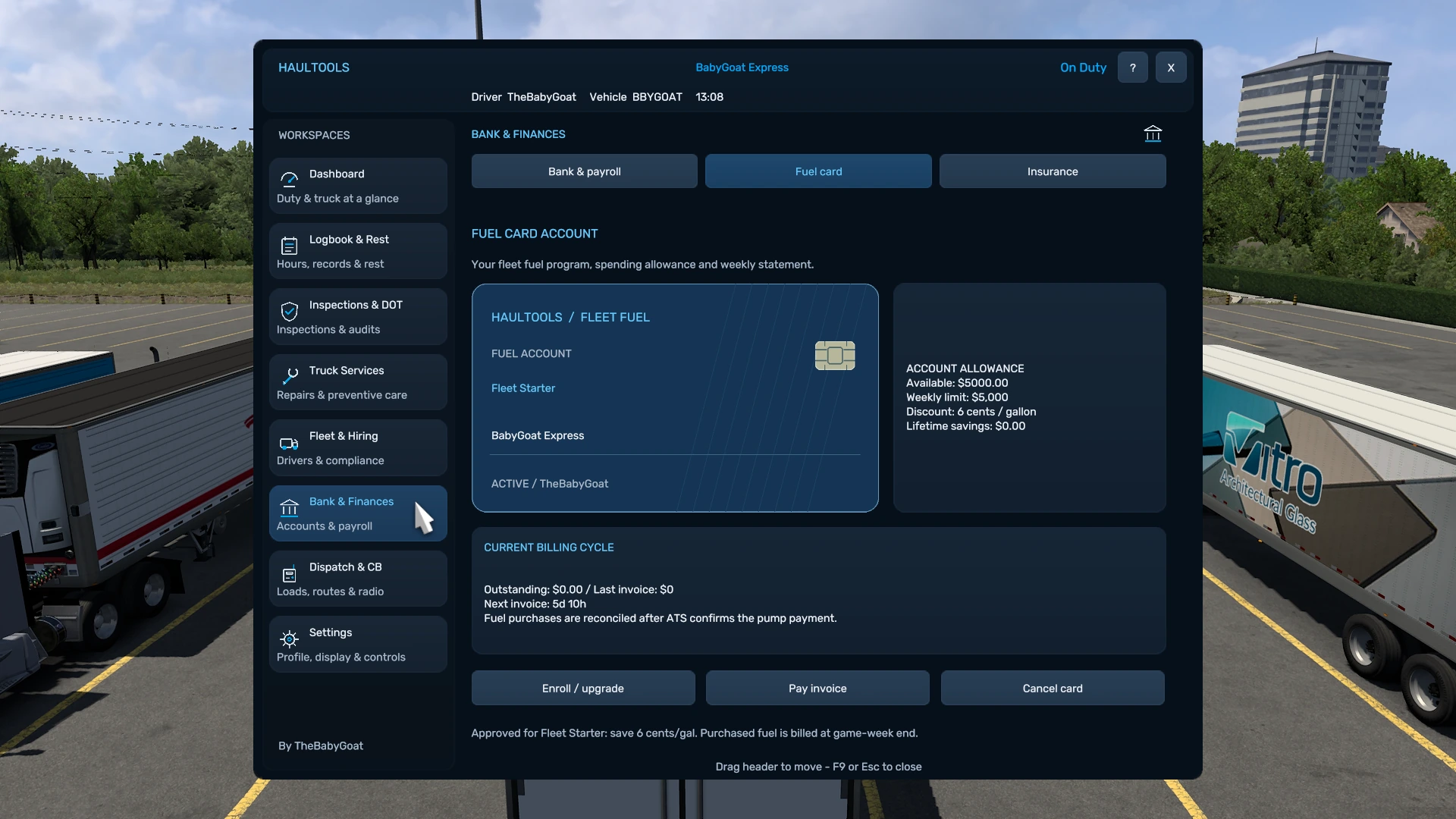
Fuel Card enrollment, tiers, savings and weekly invoices are managed separately. Review the current account and settle invoices in the Fuel Card/finance page. An alert does not pay the invoice.
Fuel Card: account/card status, available allowance, weekly invoice and payment actions.
[Simulation]
FuelRadiusFeet=150
12
Hiring & driver/truck manager
Hire into real garage capacity and verify each assignment.
Fleet & Hiring groups the company overview, applicants, job postings, Driver / truck, schedules and compliance. Job postings target Hotshot, Local or OTR work. Review the applicant, background/MVR and required screening; choose an owned terminal and save it before completing the offer, training or hire. The game rechecks garage space and bank transactions.
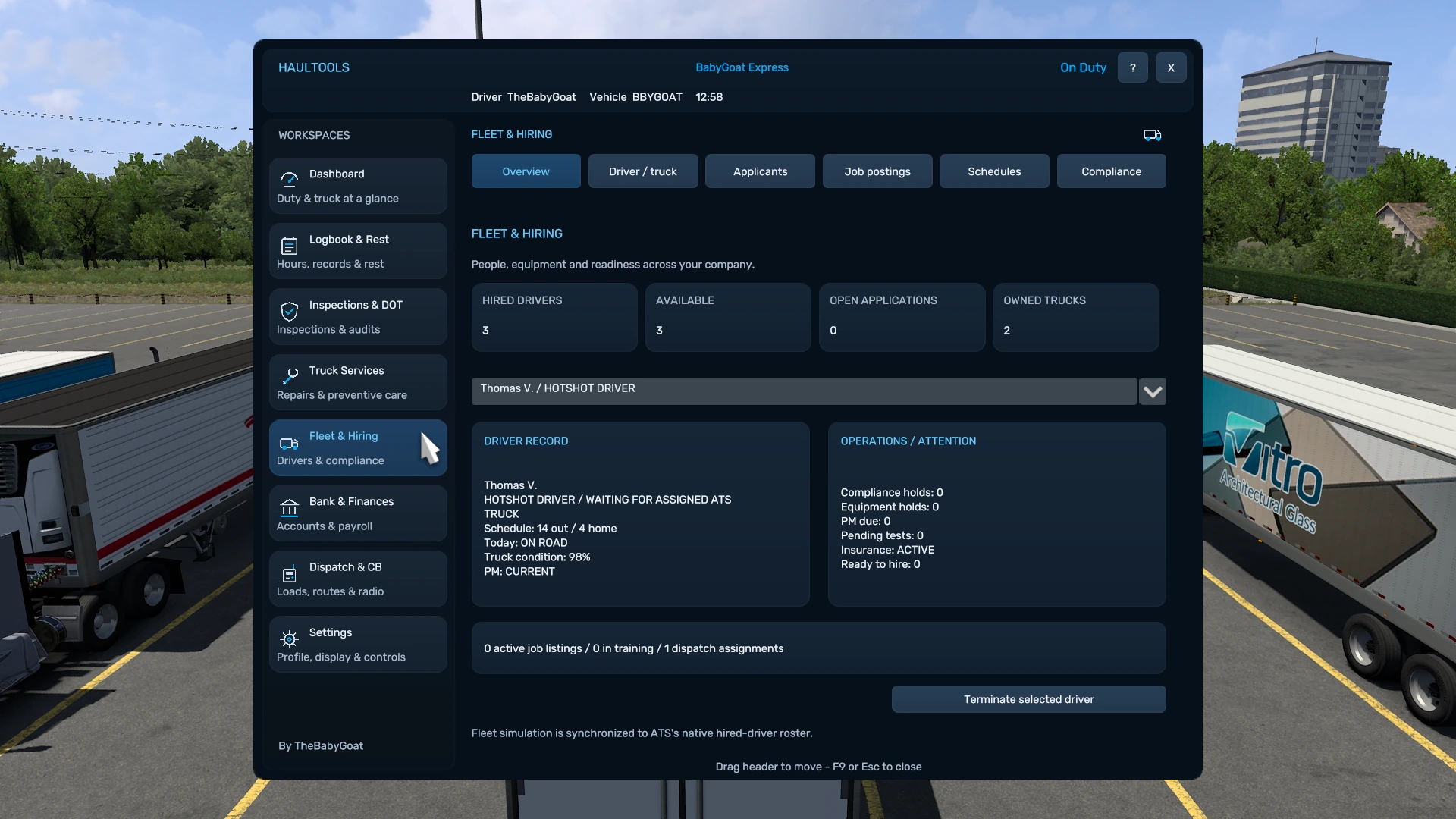
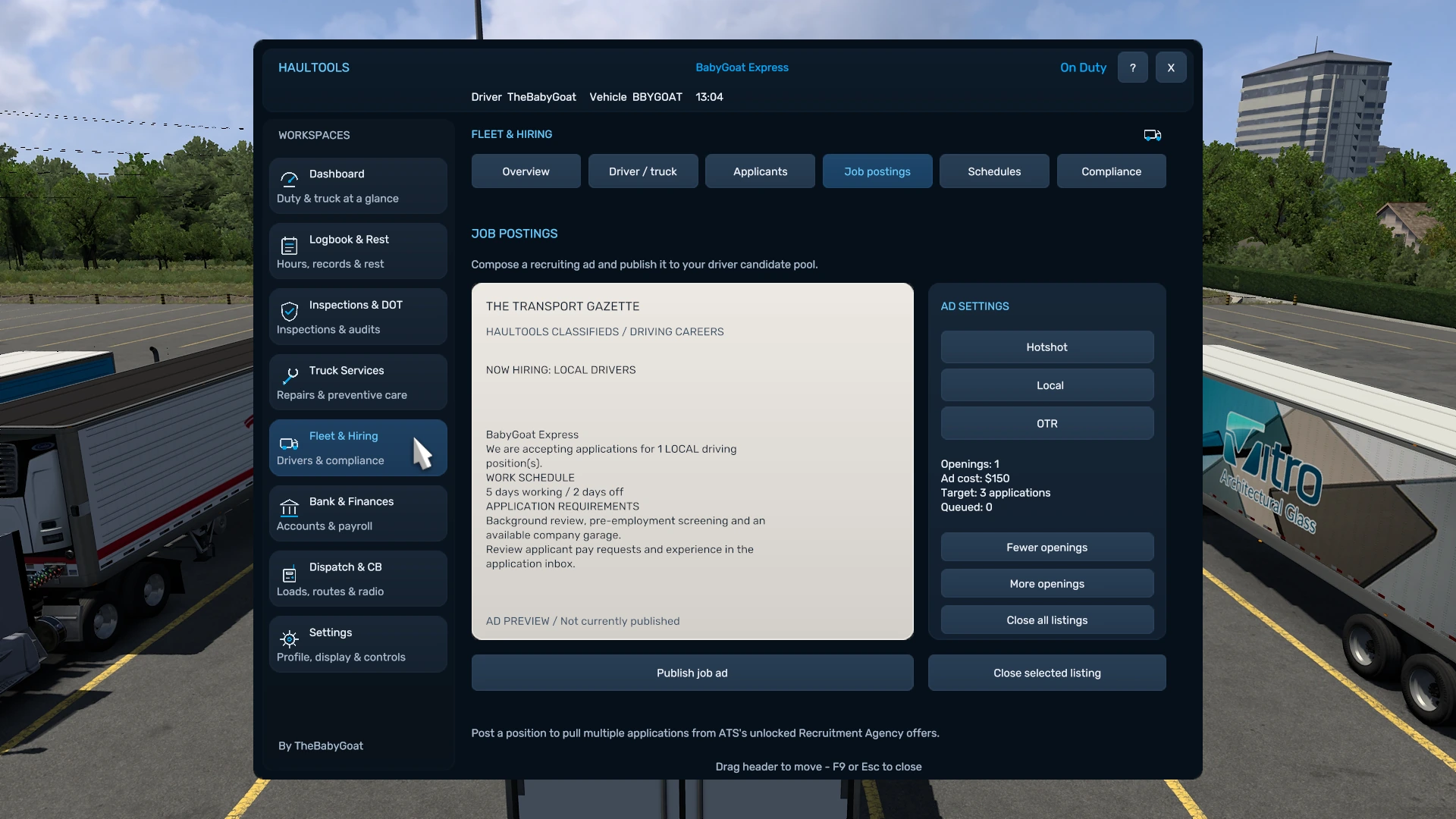
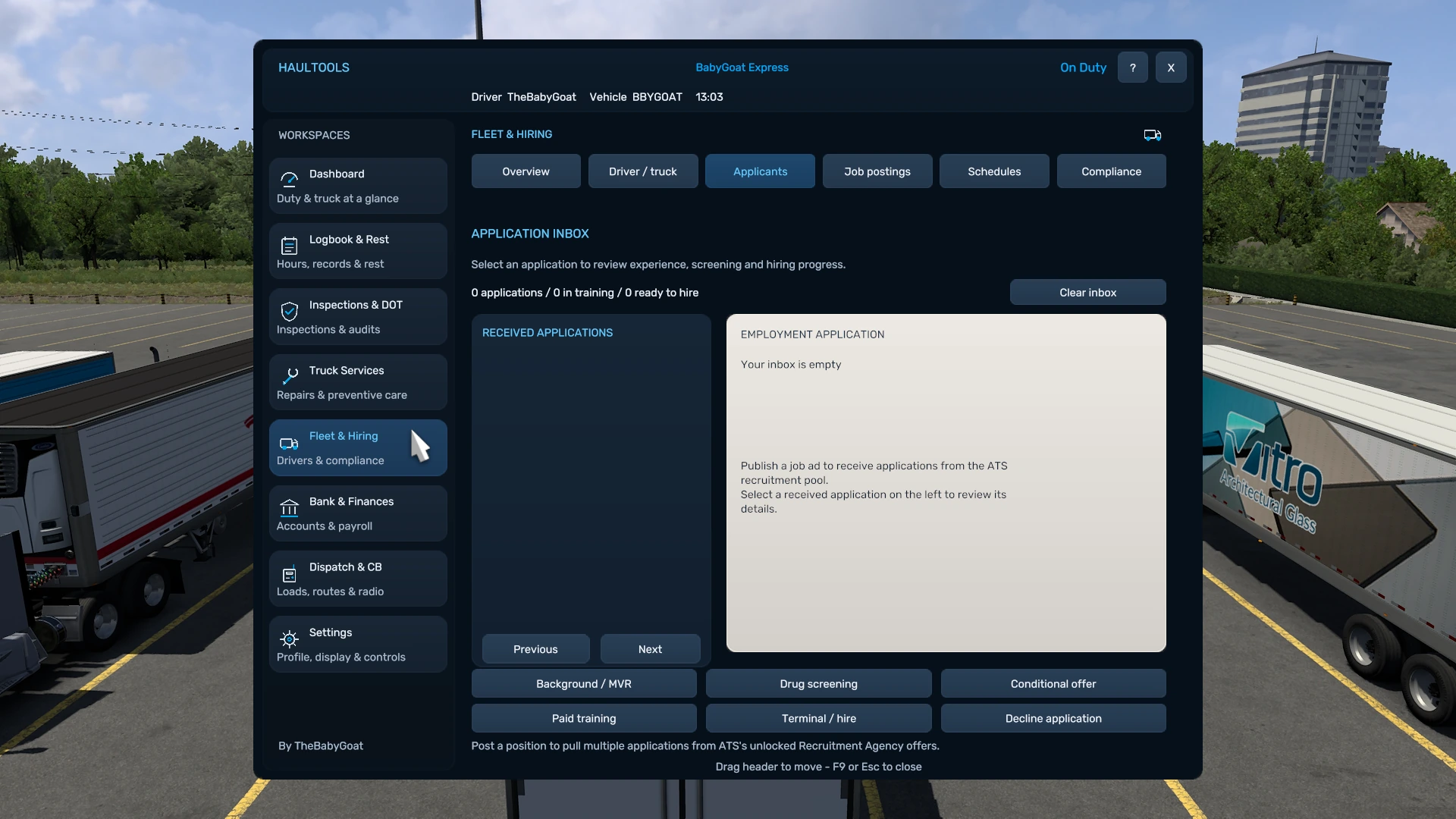
Fleet & Hiring Overview: fleet totals plus selected driver and terminal status.Job Posting: create and manage Hotshot, Local or OTR openings.Applicants: review candidates, screening details and the hiring workflow.
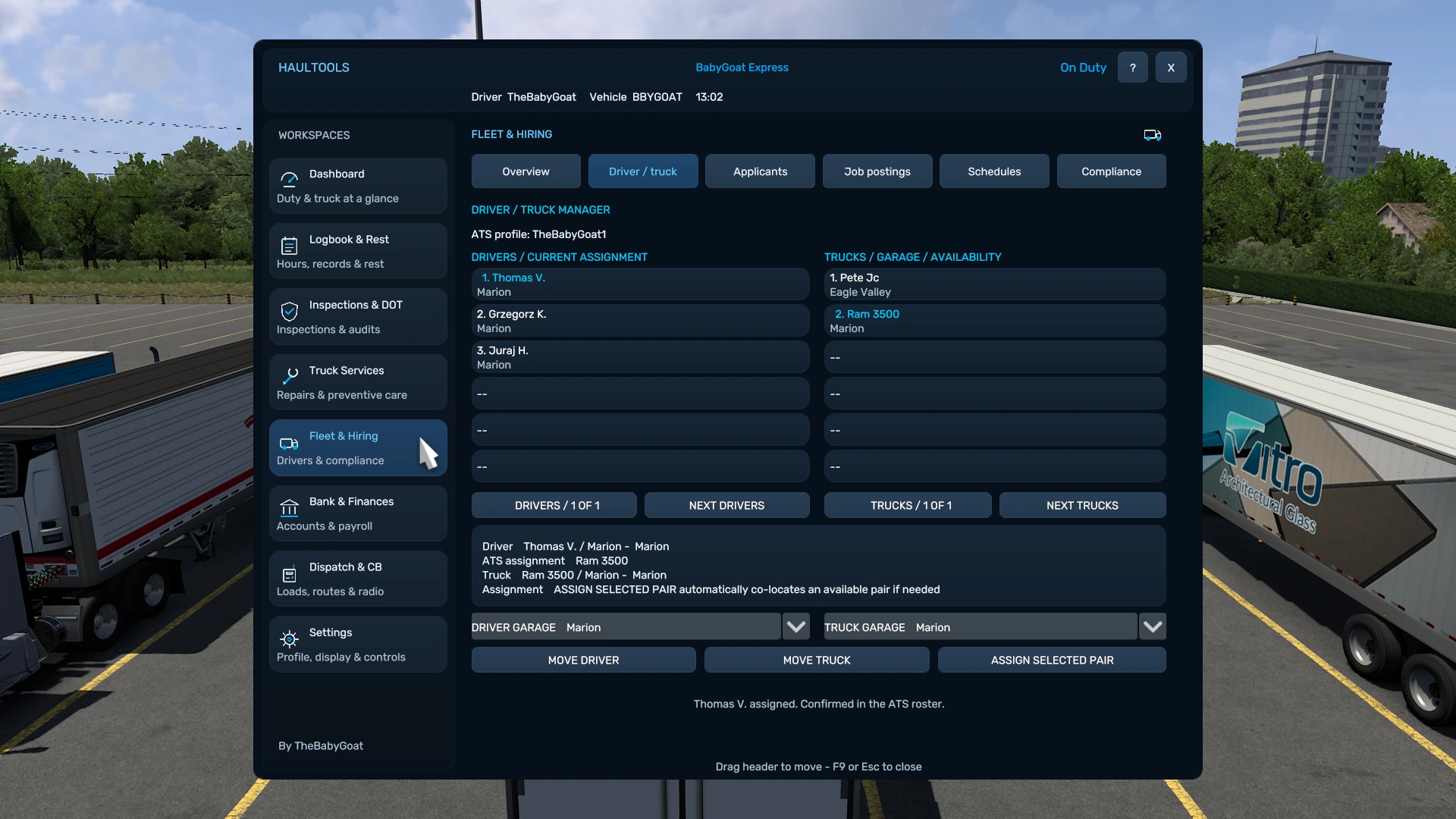
In Driver / truck, select the employee and the owned truck independently. Review their current assignment, availability and garage.
Use PREVIOUS/NEXT DRIVERS and PREVIOUS/NEXT TRUCKS to browse larger fleets. Garage dropdowns support the mouse wheel for more destinations.
MOVE DRIVER and MOVE TRUCK relocate only the selected asset. ASSIGN SELECTED PAIR assigns an available truck to an unassigned AI driver and can co-locate them when required. Read the result; the active player truck is protected.
Driver / Truck: select, move and assign ATS drivers and owned trucks.
Assignments are read back from native ATS state; fleet records belong to the current ATS profile. After switching profiles, wait for its roster to load. “Pending transaction” means an operation has not finished: avoid repeated purchases or hires until its result is known. Applicant MVR history and compliance findings are simulated gameplay records layered onto native ATS driver identity.
13
Schedules & day-off requests
Drivers request time off automatically; you approve it.
HaulTools rule
Timing in ATS game days
First request opportunity
Staggered 3–30 days after enrollment.
Later request opportunities
Randomly spaced 45–90 days apart.
Advance notice
A scheduled workday 14–28 days ahead.
Pending requests
At most one future pending request per driver.
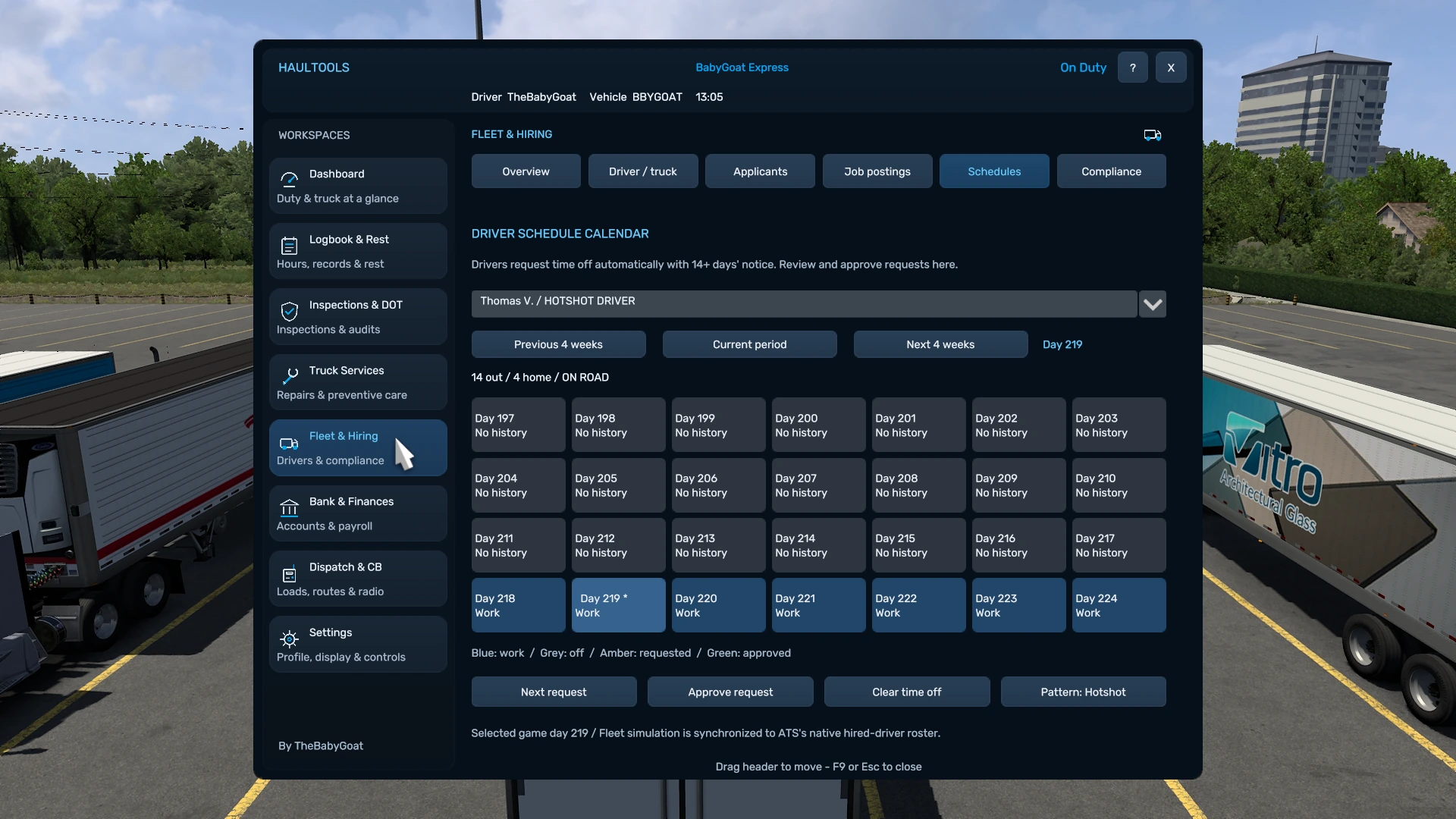
Open Fleet & Hiring > Schedules. Use Next request to jump to a pending request, including the correct driver and calendar period. Review it and select Approve request to make the day off. Clear time off declines/clears the selected entry. Receiving a notification does not approve leave.
Schedules: review workdays, approved time off and pending driver requests.
Saved work patterns and approved time off determine HaulTools dispatch availability. Requests, decisions and next-request dates survive updates/restarts per profile. Large game-time jumps create fresh requests with notice from the current day, rather than backdating them.
14
Notifications & compliance
The same notification bar follows you inside and outside the cab.
HaulTools queues drug/alcohol test selections and results, accidents, payroll due and day-off requests. Each alert receives ten seconds of visible gameplay time. F9, pause, loss of focus and cab fades hide it and pause its reading time. Unread alerts survive a restart; after the queue, the current walk instruction returns.
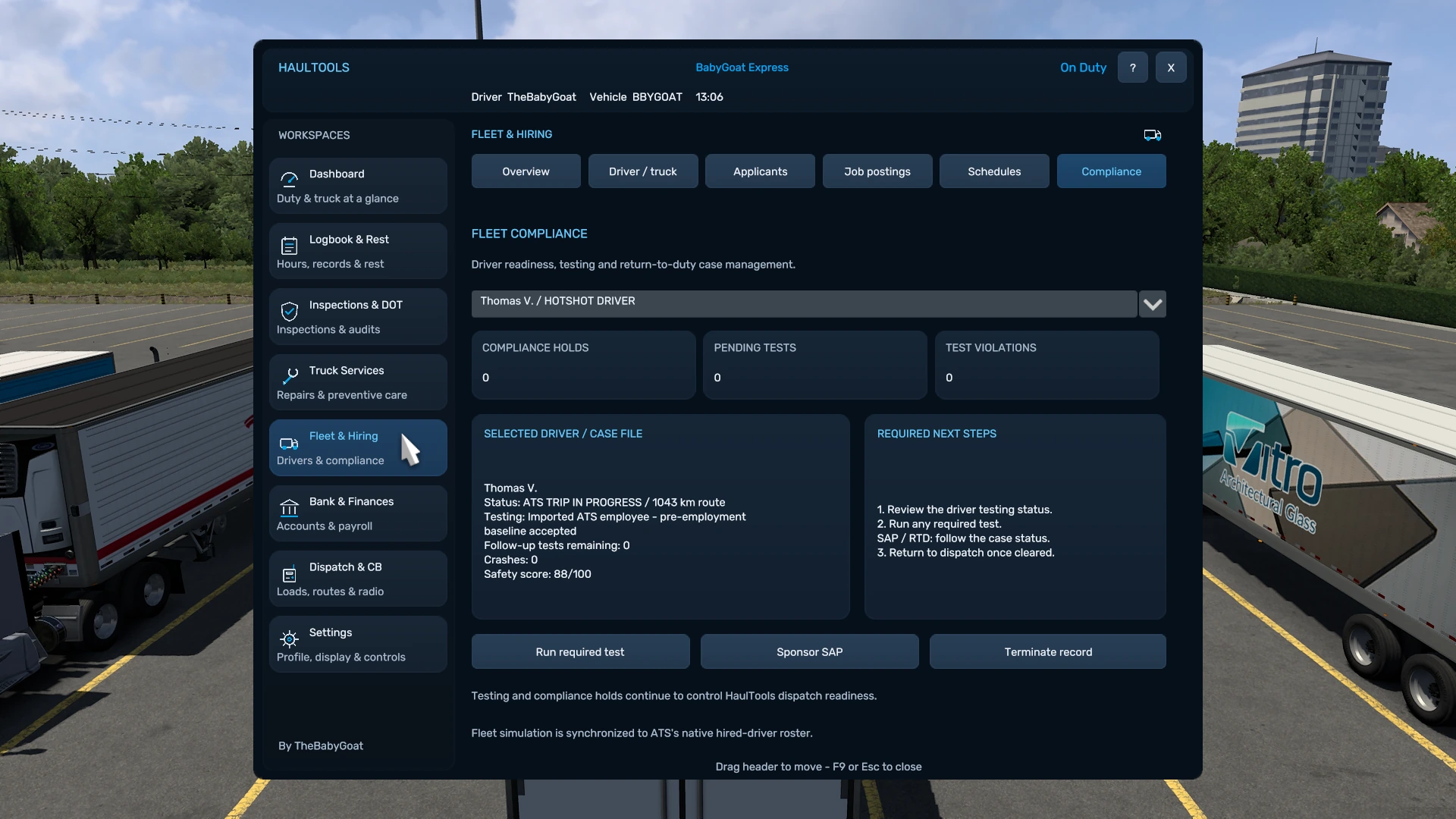
Open Fleet & Hiring > Compliance to review the affected employee, test status, deadlines and any SAP/follow-up requirements. Schedule the required action and check its outcome; an alert is not completion.
After an accident, review compliance and maintenance together before assigning more HaulTools work. Safety, schedule and service restrictions can block dispatch.
Payroll reminders occur at most once per game day while due, with only one unread payroll reminder. Paying wages and approving requests remain manual actions. Fleet simulation must be enabled for its events.
Separate operating results from settled ATS-bank transactions.
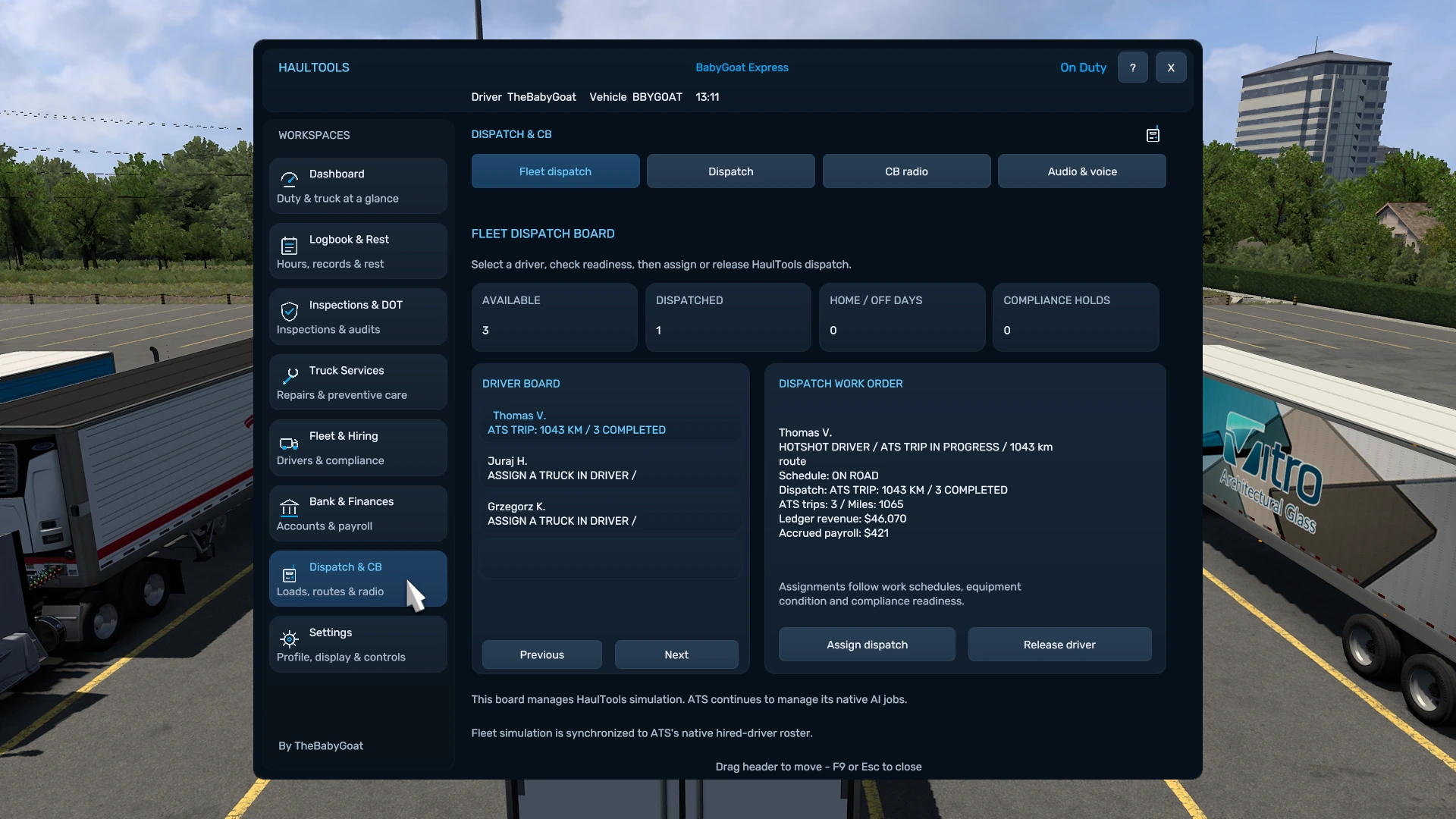
HaulTools fleet dispatch assigns eligible employees who are operational and scheduled to work. Days off and home time pause their HaulTools dispatch mileage, revenue and payroll accrual. This is separate from the player’s CB job offers and multi-stop route.
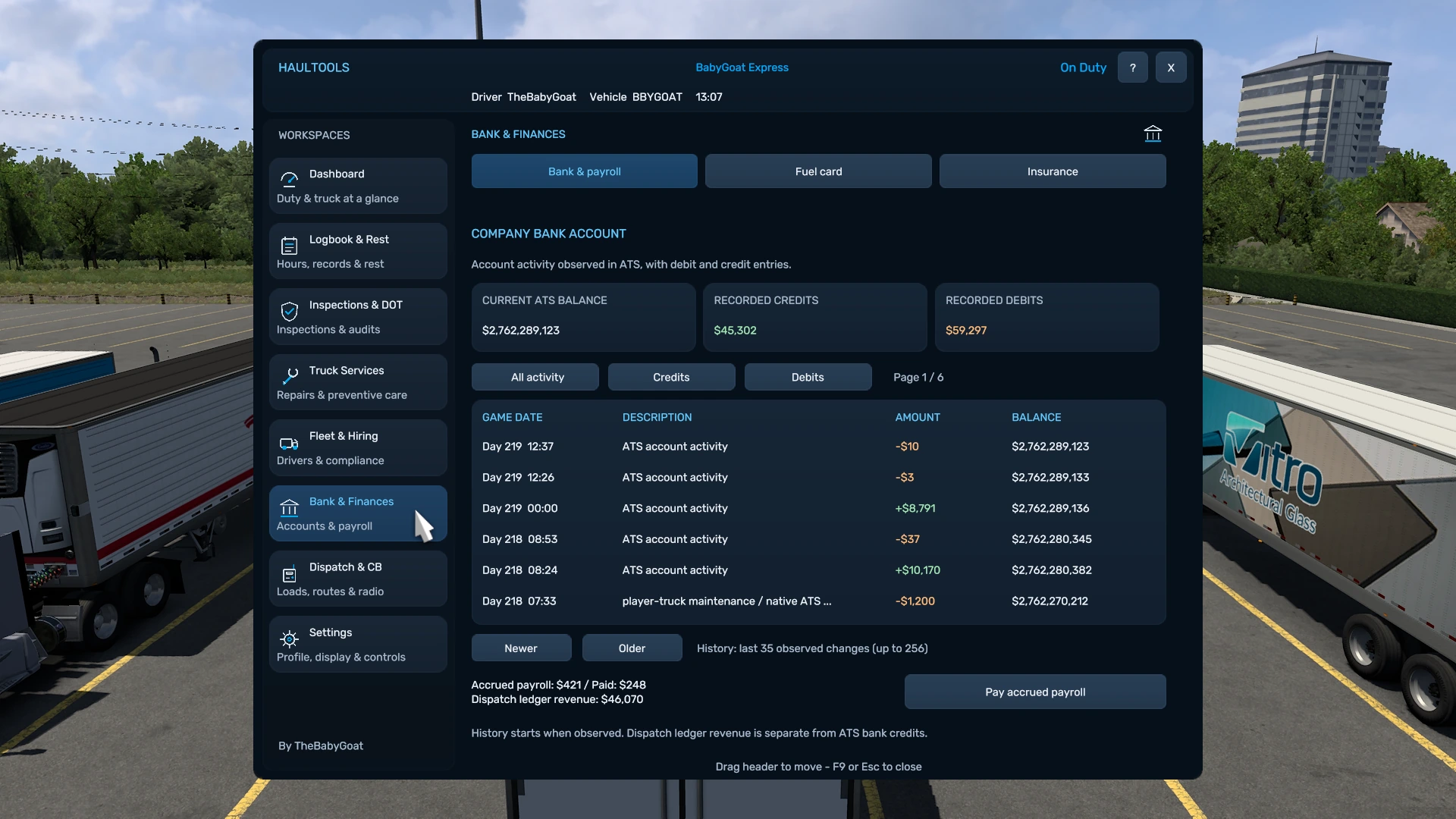
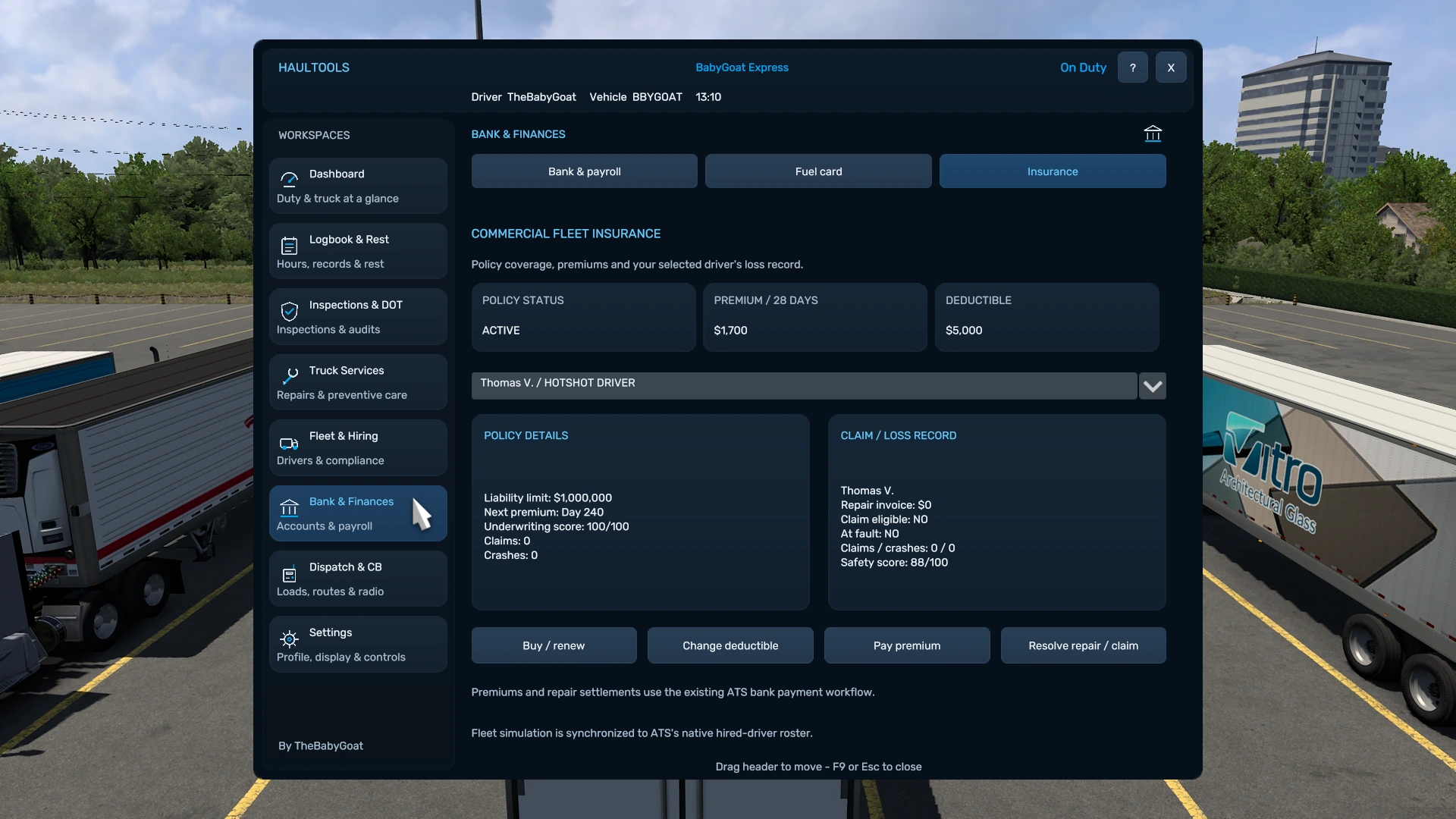
Bank & Finances exposes payroll and operating accounts. PAY PAYROLL settles accrued wages through the native ATS bank. Fuel invoices, insurance and service actions also have their own settlement flows. Review the amount and wait for confirmation before repeating an action. A displayed operating revenue/profit total is a ledger figure; do not assume every ledger entry is a fresh ATS cash credit.
Bank & Finances: company account balance, income, expenses and transaction history.Insurance: policy status, premium, claim history and payment/claim actions.
16
Truck services & maintenance
Use condition and mileage to plan service.
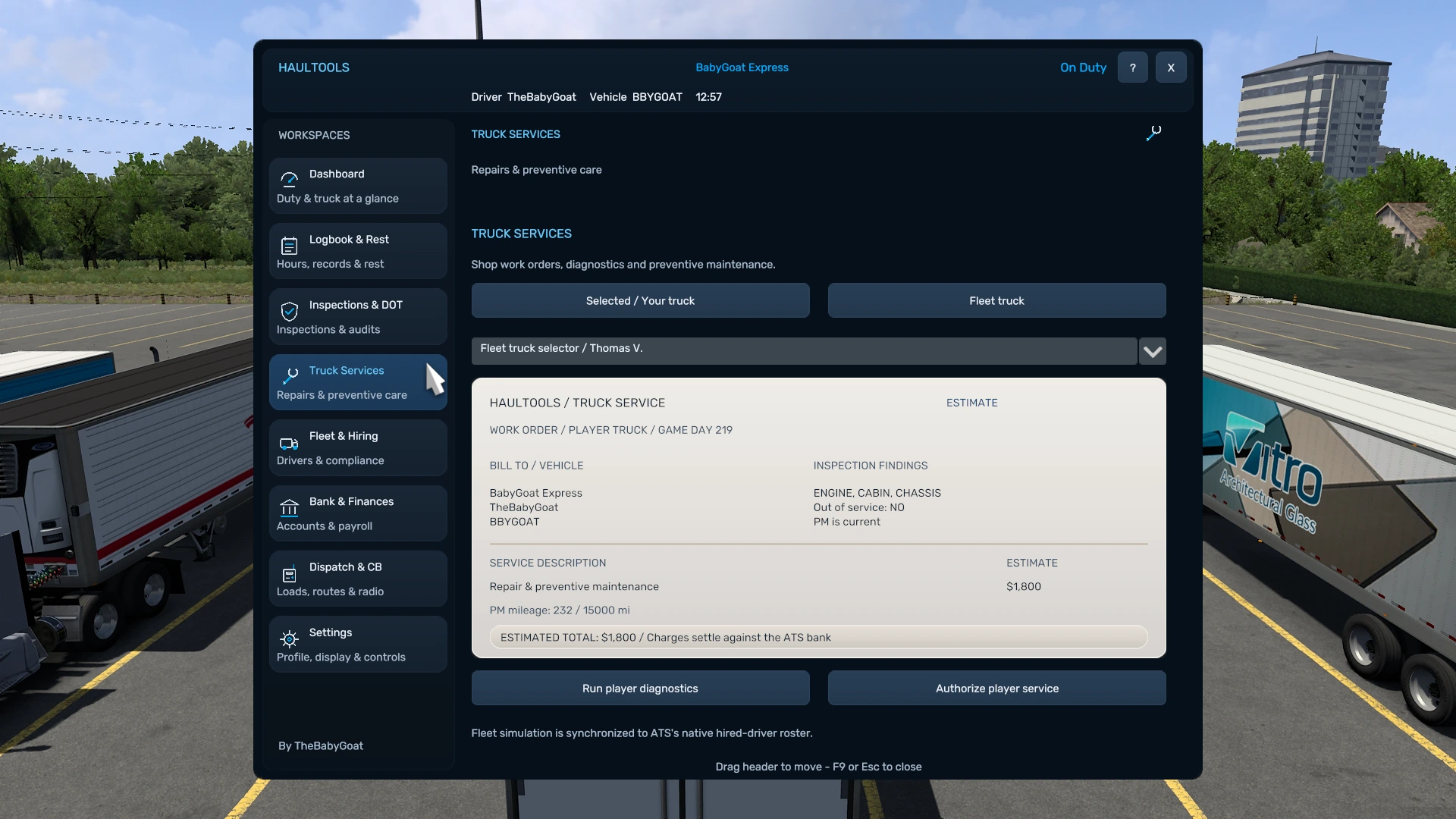
Open Truck Services to review the player truck’s diagnostics, condition and preventive-maintenance status. The default player PM interval is 15,000 tracked miles.
Review the indicated repairs, service amount and bank result. A repair-only action does not reset preventive maintenance. Native shop repairs can clear matching repair items once ATS confirms the damage state.
Use the fleet maintenance view for employee trucks. Accident damage, wear, random repairs and overdue service affect operational availability. Resolve the actual fault before returning a restricted employee to dispatch.
Truck Services: diagnostics, condition, preventive-maintenance status and service invoice.
Telemetry gauges describe the truck’s reported condition. A warning lamp alone is not a fabricated HaulTools failure, and minor damage does not automatically mean an out-of-service order. Keep an eye on both the service page and explicit DOT findings.
17
Simulation & personal settings
Choose the features you want to use.
Settings > Simulation
What it changes
Outside trailer service
Outside legs/lines/release workflow. Off restores native coupling.
Fueling prompts
Pump progress notifications.
Walk inspections
Physical inspection guidance and markers; desk records remain.
Walking / running sounds
Embedded footsteps.
Fleet / Hiring simulation
HaulTools employee events and applicant/onboarding processing.
CB radio
Radio power, shared with the CB page/hotkey.
Random DOT checks
Future HaulTools random checks; existing findings remain.
Automatic duty changes / Sleep Anywhere
Automatic driving status / supported rest-anywhere behavior.
Master simulation
Pauses ELD/DOT/CB/Fleet/Hiring simulation while retaining individual preferences. Walk switches remain independent.
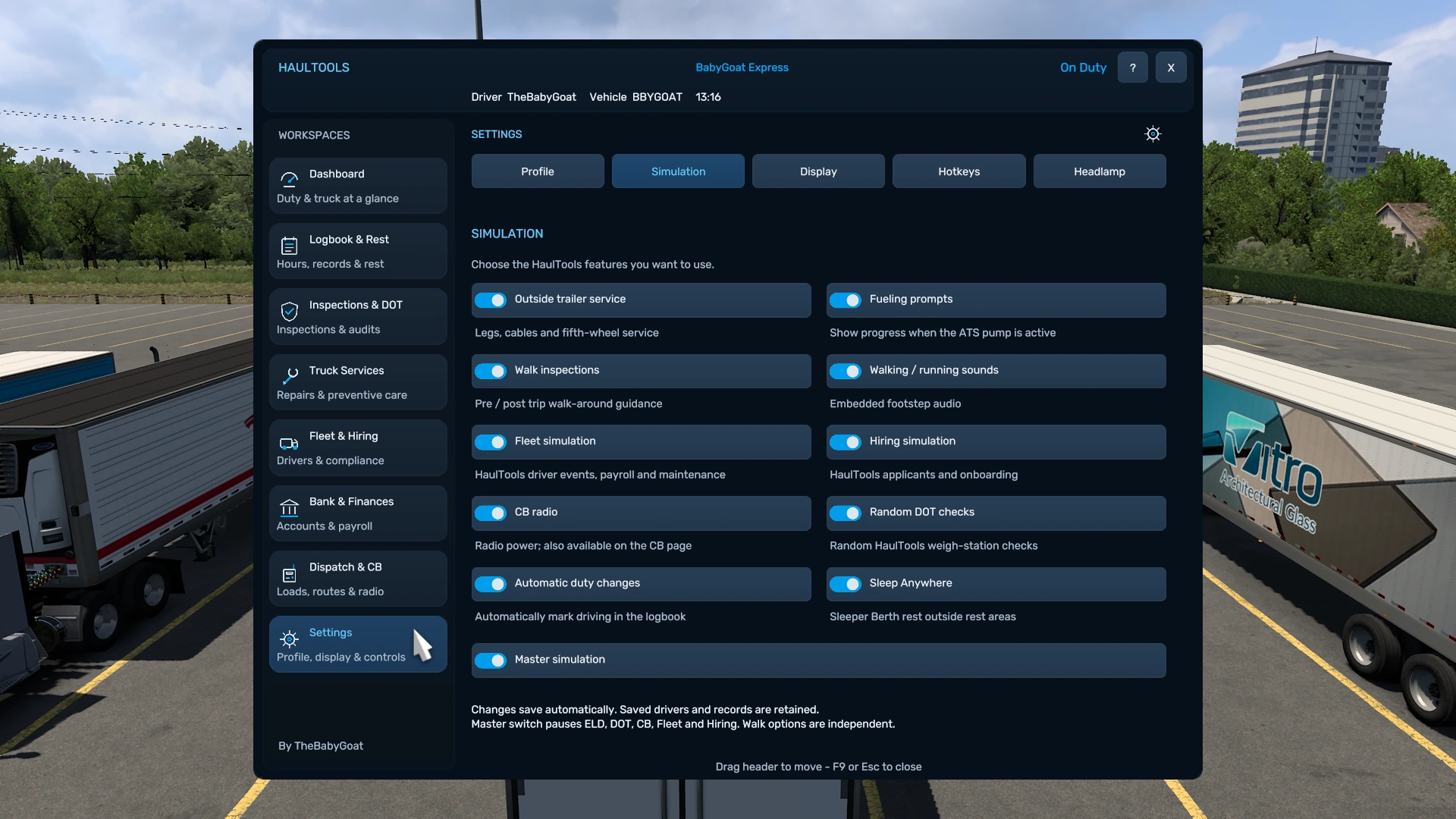
Settings > Simulation: enable or disable the HaulTools simulation systems you want to use.
Finish an active coupling or walk inspection before disabling it. Turning simulation off is not a reset of debts, paid records or expiry dates. On re-enable, skipped daily events are not replayed, but existing obligations still use ATS time. Normal ATS AI drivers continue while HaulTools fleet simulation is off.
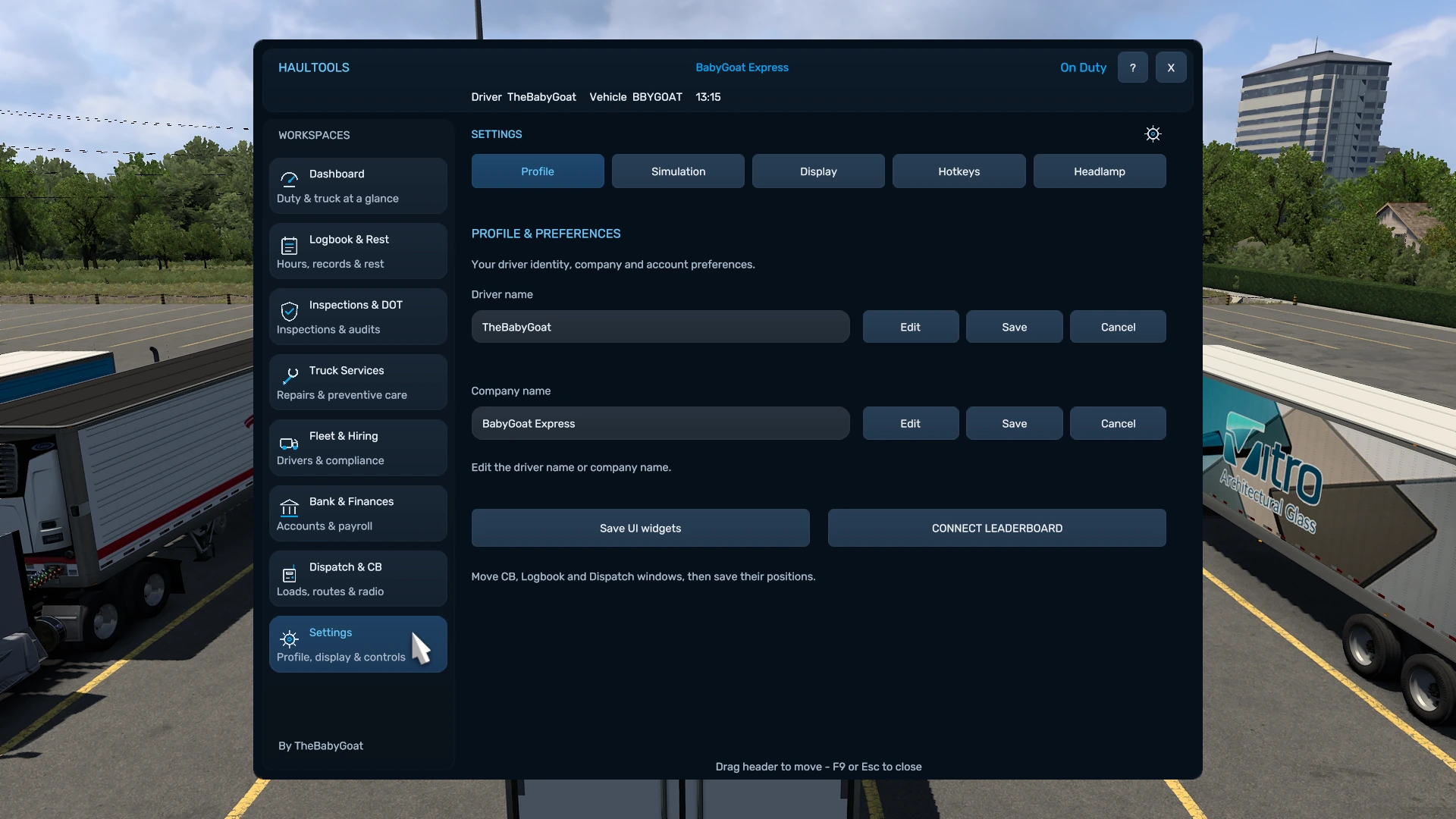
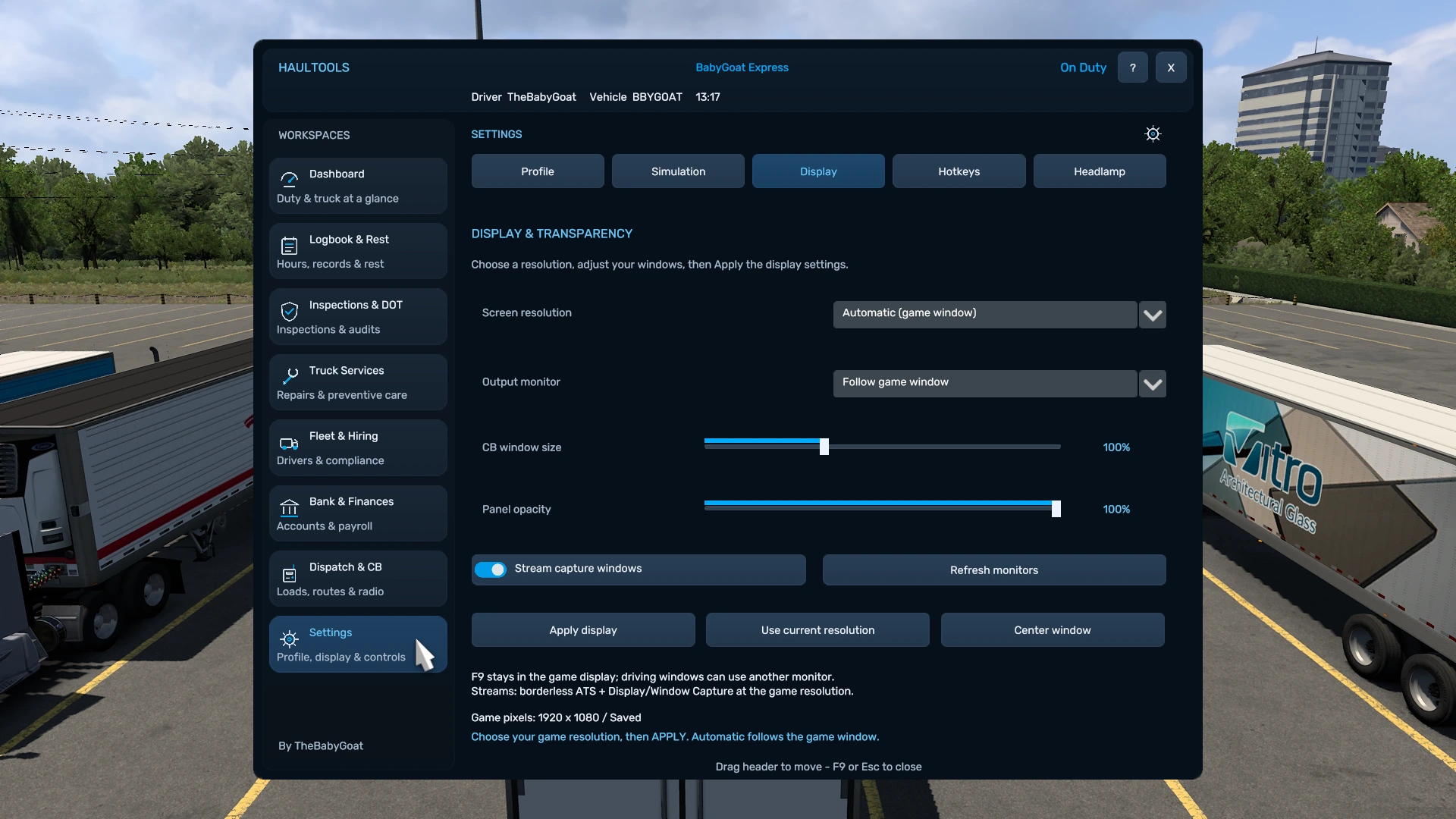
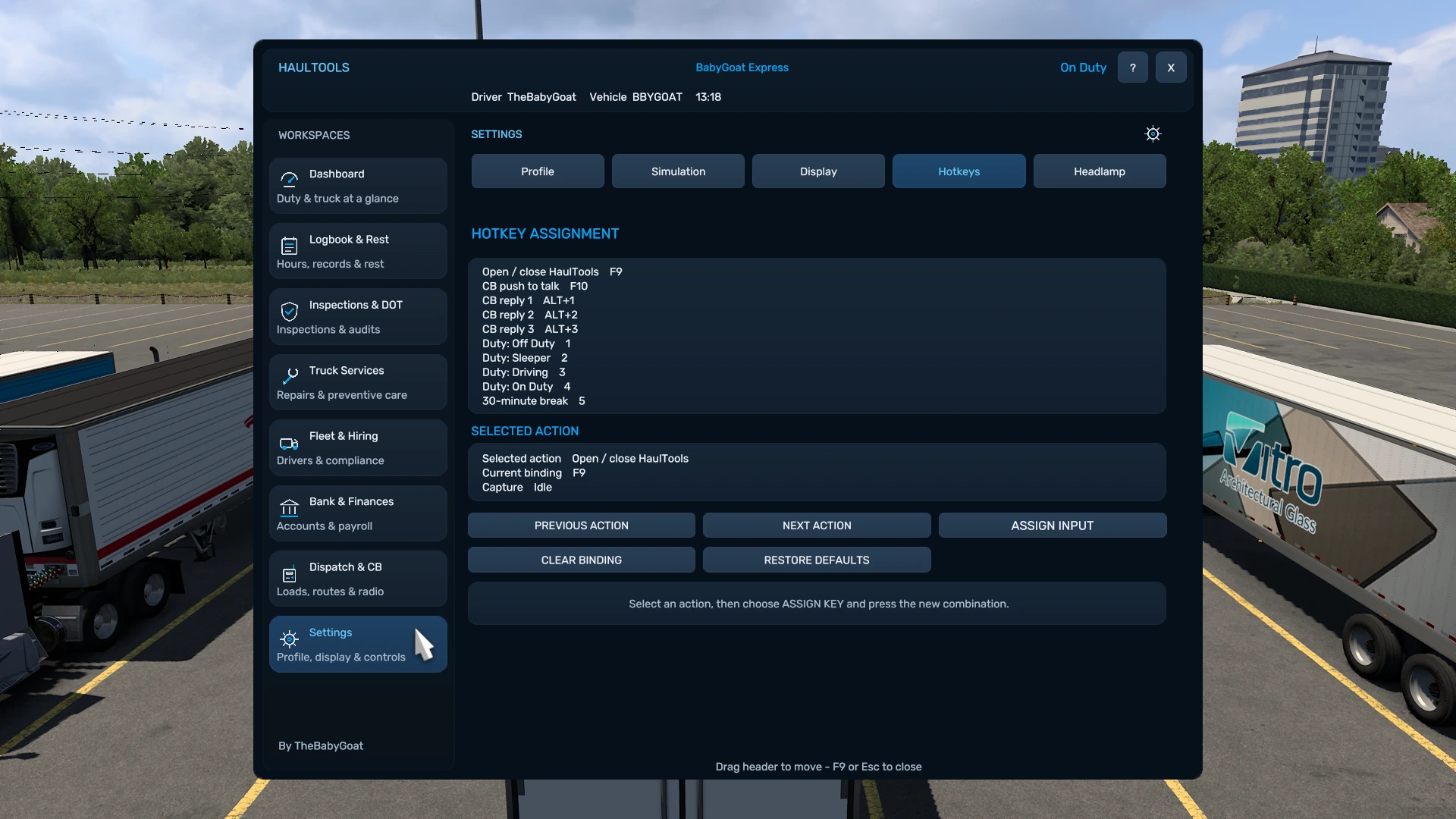
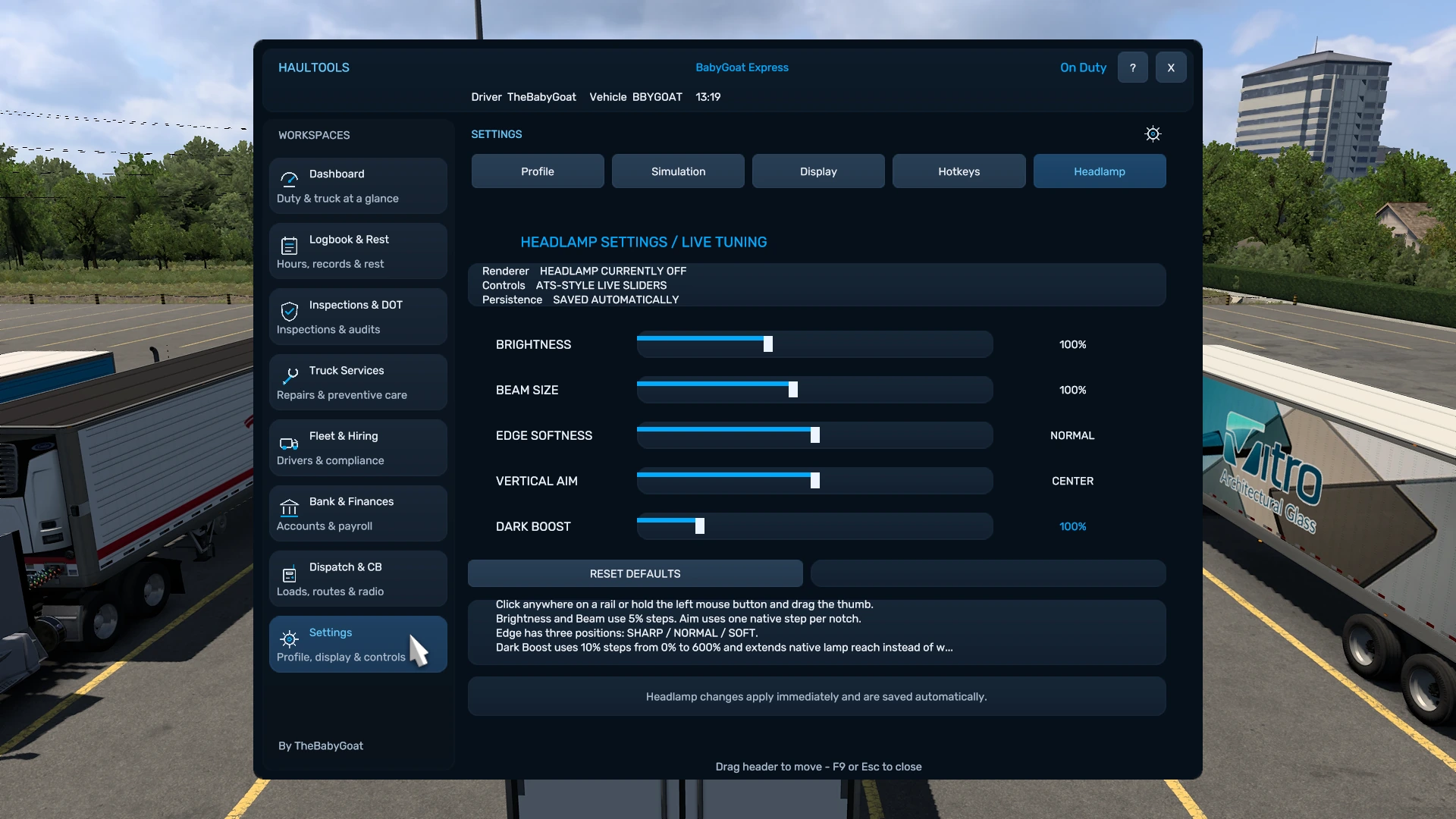
Profile holds identity details; the master switch is on Simulation rather than duplicated on Profile. Display adjusts HaulTools layout/opacity and monitor selection; it does not change the actual ATS video mode. Headlamp adjusts brightness, beam, aim and edge. Hotkeys handles supported keyboard/controller assignments; wheels and button boxes remain under ATS’s normal controls.
Settings > Profile: driver/company identity and account controls.Settings > Display: monitor selection, UI opacity/layout and reset controls.Settings > Hotkeys: review and assign supported keyboard/controller controls.Settings > Headlamp: adjust brightness, beam size, aim and edge.
18
Updates, saves & backups
Keep the data; replace the release files.
Close ATS. Back up your ATS profile and the complete %LOCALAPPDATA%\HaulTools folder together. Include profile backups appropriate to your Steam/local save setup.
Install the new matching DLL and SCS, plus any updated runtime/audio files supplied for that release. Update-only packages reuse the already-installed runtime. Do not replace active personal settings with release defaults.
Keep the SCS enabled for the correct profile, launch ATS and verify F9, audio, current fleet and inspection records. Keep the backup until you are satisfied with the update.
Location
Contains
%LOCALAPPDATA%\HaulTools\config
Active preferences, configuration and local license data.
%LOCALAPPDATA%\HaulTools\profiles
Separate profile records, including fleet, logbook and inspection state.
%LOCALAPPDATA%\HaulTools\logs\HaulTools.log
Current-session support log. Copy it before restarting.
<ATS user folder>\HaulTools Installer Backups
Replaced mod-file backups made by the installer.
19
Convoy & compatibility
Shared world, local HaulTools records.
Use a HaulTools release built for your actual ATS executable. The public version number alone is not enough for native integrations; unsupported builds can block F9 or selected native features.
In Convoy, sleeper/break actions do not advance the shared clock. Native job mutations, including multi-stop creation, remain disabled. Services can wait while joining, loading or changing sessions.
Each user needs their matching local plugin/UI files. Follow the server’s mod requirements. The CB system is not multiplayer voice chat; HaulTools company and logbook data are local rather than a shared company database.
Discarding ATS session progress does not automatically roll back HaulTools’ separate saved files. Keep or restore the ATS/HaulTools backups together. Test your exact game/server/mod combination; this guide does not establish compatibility with every combination.
20
Troubleshooting
Start with the symptom and check the matching files first.
Symptom
Check / next step
F9 does not open
Load the truck world; check the hotkey, exact ATS build, DLL location and active matching SCS. Read the support log for an unsupported executable or missing UI resource.
Menu snaps back / cannot select
Confirm the DLL and SCS came from the same release. Disable duplicate older HaulTools UI packages and restart.
CB silent or fallback voices
Check power, voice volume, selected output and plugins\HaulTools\audio\cb\cb_audio.htpak. Look for missing/failed recordings in the log. An incomplete audio pack needs the proper release asset.
Voice command not recognized
Select the microphone, verify Windows permission, hold PTT and use an English supported phrase. Wait for a free channel; try the corresponding UI action to isolate recognition from dispatch.
Trailer lines/legs skip outside work
Check Outside trailer service, the supported build and matching SCS. Use a genuinely detached trailer for the test; already-complete save/load hookups are intentionally kept complete. Follow current prompts.
No multi-stop offer / unloading blocked
Check single-player, eligible body/cargo, parked state, skills, road/depot availability and current job state. For unloading, check the correct receiver, distance, height, brake, connected trailer and dwell time.
No refuel prompt in another aisle
Move closer to the actual fuel trigger; confirm engine/stopping conditions. Height, mixed-action or unsupported triggers keep normal limits. FuelRadiusFeet=0 restores stock range.
No requests or fleet alerts
Enable fleet/master simulation, load the correct profile and check linked active employees. Initial request opportunities are staggered over 3–30 game days. Alerts pause during menus, fades and focus loss.
Installer rejects a ZIP / broken archive
Use a complete compiled release, not source or a patch. Redownload a truncated archive and check the published size/checksum when supplied. Do not mix files from unrelated builds.
What to send for support
Save HaulTools.log before restarting ATS, plus the ATS user folder’s game.log.txt, a screenshot, your HaulTools/ATS versions and the steps that reproduce the problem. Include whether you use VR, Convoy, a custom truck/trailer or a redirected user folder. Do not post license files, keys or tokens. The creator credit is TheBabyGoat; Discord: the.baby.goat.
21
Building from source
For creators and testers; players use the compiled release.
The organized HaulTools source keeps launchers in scripts/ and release notes in docs/releases/. Extract it into a fresh folder and open HaulTools.sln. Use Windows with Visual Studio 2022’s Desktop development with C++ workload. A complete release build also needs the full CB audio pack or verified original parts.
Script
Use
scripts\BUILD_UPDATE.bat
Build matching DLL + SCS into dist_update.
scripts\BUILD_DIST.bat
Build a complete hardened release into dist.
scripts\BUILD_DLL_ONLY.bat
DLL only; does not update UI resources.
scripts\INSTALL_UPDATE.bat
Install the staged DLL/SCS with ATS closed.
scripts\RESTORE_CB_AUDIO.bat
Assemble the original audio parts when present.
For a single-file customer installer, add the separate installer builder kit beside the solution. BUILD_INSTALLER.bat builds/packages a complete release; PACKAGE_INSTALLER_FROM_DIST.bat packages an already complete dist. These belong to the installer kit and are not included in the HaulTools source cleanup. Always test the built release in ATS before distributing it.
Guide scope
Prepared from the organized HaulTools source, its current configuration, native UI bindings, release notes and installer 1.0.1. The guide documents that build, not unverified later updates. Screenshots are visual references; game text, saved settings, hardware and custom vehicles can differ. The HTML translations cover this document only.
01
Conoce HaulTools
Tu camión, tu jornada, tu empresa.
HaulTools añade sistemas de conducción y gestión empresarial a American Truck Simulator: registro de jornada, inspecciones, servicio exterior del remolque, conversaciones por radio CB, despacho, entregas con varias paradas, empleados, mantenimiento y finanzas. Esta guía cubre HaulTools para la compilación compatible de ATS 1.61.1.1 en Windows x64.
Vista general del panel: estado del conductor, trabajo actual, estado de servicio y datos del camión.
Cómo encajan sus componentes
HaulTools.dll ejecuta el complemento y las integraciones nativas compatibles. La telemetría de ATS aporta datos del camión, la hora y el trabajo.
HaulTools_Tools.scs proporciona la interfaz del juego correspondiente. La carpeta de recursos contiene el paquete de audio CB y la configuración predeterminada.
Los registros de la empresa y las preferencias se guardan aparte de la DLL instalada. Los interruptores permiten elegir qué funciones de simulación utilizar.
02
Instalar el mod
Instala juntos la DLL, los recursos y el SCS correspondiente.
Cierra ATS. Usa la versión completa y compilada de HaulTools correspondiente a tu juego. Un ZIP de código fuente sirve para desarrollo; un paquete de actualización supone que los recursos y el audio completos ya están instalados. El instalador comprueba el ejecutable real: una variante VR o revisión con el mismo número visible puede ser incompatible.
Opción A · Instalador de HaulTools
Ejecuta el EXE de instalación. La edición independiente pide el ZIP completo; la edición integrada ya lo contiene.
Revisa la carpeta del juego y la carpeta de usuario detectadas. Confirma Documentos de OneDrive o la ruta personalizada -homedir si la utilizas.
Selecciona Install HaulTools y completa la solicitud de administrador de Windows. El programa valida los archivos y respalda los que sustituye.
Inicia ATS, activa HaulTools v2.0 en Mod Manager para tu perfil, aplica los cambios y carga el camión.
Referencia del instalador independiente. La edición con contenido integrado no necesita seleccionar otro ZIP.
Opción B · Instalación manual
Archivo del paquete
Destino
HaulTools.dll
<ATS>\bin\win_x64\plugins\HaulTools.dll
HaulTools/
<ATS>\bin\win_x64\plugins\HaulTools\
HaulTools_Tools.scs
<ATS user folder>\mod\HaulTools_Tools.scs
Encuentra la carpeta del juego con la opción de Steam para explorar archivos locales. La carpeta de usuario suele ser Documents\American Truck Simulator, aunque puede estar redirigida. Copia el contenido de las carpetas del paquete a los destinos reales. La subcarpeta del juego es win_x64. Evita una carpeta doble HaulTools\HaulTools. Activa el SCS y desactiva las copias antiguas de la interfaz de HaulTools.
03
Primer inicio y activación
Carga el camión, activa el mod y ajusta tus preferencias.
Carga tu perfil de ATS y espera a que el camión esté listo en el mundo. Pulsa F9 para abrir HaulTools.
Si se requiere activación, elige SIGN IN WITH PATREON y sigue el proceso del navegador con la cuenta que tiene acceso a HaulTools. Vuelve al juego y comprueba el estado. Mantén internet durante la activación.
Completa la configuración inicial si aparece. Introduce conductor y empresa; revisa el estado de servicio, el ciclo de horas, los dispositivos de audio y Settings > Simulation.
Antes de una jornada normal, completa la inspección previa, confirma el servicio del remolque, revisa la ruta activa y las tareas pendientes de la empresa.
04
Controles y áreas de trabajo
Se muestran valores predeterminados; prevalecen tus asignaciones guardadas.
Acción
Predeterminado
Interfaz principal / cerrar
F9 · Esc
Salir / entrar en cabina
F12
Caminar / correr / linterna
W A S D / ↑ ↓ ← → · Shift · Ctrl + F12
Pulsar para hablar / respuestas CB
F10 · Alt + 1 / 2 / 3
Encendido de CB
Ctrl + Shift + R
Ventanas CB / registro / despacho
Ctrl + Shift + C / L / D
Interactuar con ventanas pequeñas
Ctrl + Shift + M
Fuera de servicio / litera / conducción / en servicio / pausa
1 / 2 / 3 / 4 / 5
Las acciones del remolque usan tu tecla de ATS Trailer attach/detach, normalmente T. Las inspecciones a pie usan la tecla de activación detectada, con E como alternativa; sigue siempre el aviso en pantalla. Cambia las asignaciones compatibles en Settings > Hotkeys. F12 y las combinaciones reservadas no equivalen a teclas normales de menú.
Las áreas principales son Dashboard, Logbook & Rest, Inspections & DOT, Truck Services, Fleet & Hiring, Bank & Finances, Dispatch & CB y Settings. El botón ? ofrece ayuda contextual. Para colocar ventanas pequeñas, activa la interacción, arrástralas, usa Save UI widgets en Settings y desactiva la interacción.
05
Modo a pie
Trabaja alrededor del camión estacionado.
Estaciona y asegura el camión antes de pulsar F12. Espera a que termine la transición. Muévete con WASD/flechas, mira con el ratón y mantén Shift para correr.
Los controles del camión quedan aislados al caminar. La protección contra daños por contacto a pie protege camión, remolque y carga; no es un ajuste general de daños al conducir.
Los sonidos de caminar y correr están integrados. Puedes desactivarlos en Settings > Simulation. Usa Ctrl+F12 para la linterna y Settings > Headlamp para ajustar el haz.
Lee la barra de notificaciones para conocer la siguiente acción. Pulsa F12 para volver a la cabina. Los avisos se ocultan durante las transiciones.
Referencia del juego: una inspección terminada necesita el informe firmado. Sigue el aviso actual de la esquina superior derecha.
06
Conectar y desconectar remolques
Primero el acoplamiento mecánico; después el servicio exterior.
Enganchar
Activa Outside trailer service en Settings > Simulation. Retrocede siguiendo el acoplamiento de ATS; con Advanced Coupling, alinea correctamente el perno rey. Usa la tecla de enganche si ATS pide el acoplamiento mecánico.
Con la quinta rueda bloqueada, sigue el aviso y sal con F12. En los puntos indicados, sube las patas si corresponde y conecta después las líneas neumáticas/eléctricas con la tecla mostrada.
Espera la confirmación de enganche completo antes de conducir. Un remolque ya conectado al cargar una partida no requiere repetir el proceso por motivos visuales.
Después de conectar la quinta rueda con el sistema nativo, sal de la cabina y completa el servicio exterior de enganche.Sube las patas del remolque cuando se indique durante el enganche.Vuelve a conectar las líneas de aire del remolque cuando se indique.El enganche termina después de conectar las líneas de aire; vuelve a la cabina.
Desenganchar
Inicia el desenganche y sigue los avisos exteriores. En remolques con patas, bájalas, desconecta las líneas y completa el paso de la palanca de liberación de la quinta rueda. En uno verificado sin patas, desconecta las líneas fuera, vuelve con F12 y usa el desenganche nativo de ATS cuando se indique. Desconectar las líneas no libera por sí solo la quinta rueda.
Inicia el flujo completo de desenganche exterior con el conjunto estacionado y asegurado.Baja las patas del remolque cuando se indique durante el desenganche.Desconecta las líneas del remolque antes de completar la liberación de la quinta rueda.
07
Inspecciones antes y después del viaje
Revisa cada punto y firma junto a la puerta del conductor.
Estaciona, abre Inspections & DOT e inicia la inspección previa o posterior correspondiente. Sal de la cabina cuando se indique.
Sigue el marcador cian hasta el punto del camión o remolque. Está anclado a esa zona y se ve a distancia. Acércate hasta que aparezca la acción.
Pulsa la tecla indicada para marcar el punto como correcto. Mantén Shift con esa tecla para registrar un defecto. Completa todos los puntos requeridos; no marques como correcto un defecto conocido.
Vuelve al marcador de la puerta y usa la tecla indicada para firmar. Espera PRE-TRIP SIGNED o POST-TRIP SIGNED. Iniciar o completar la lista sin firmar no crea un informe firmado.
Inspecciones y DOT: inicia inspecciones a pie antes/después del viaje y revisa las herramientas DOT.Inspección a pie: sigue el aviso de la estación activa alrededor del camión.La inspección a pie continúa alrededor de todo el conjunto camión/remolque a medida que se completa cada estación.
El registro conserva los informes y puede revisarse en un control DOT. Completa la inspección posterior al terminar el día del juego. Desactivar Walk inspections conserva los registros desde el menú. Los marcadores son zonas de servicio, no puntos exactos del modelo; un chasis modificado o una combinación muy articulada puede situar la zona lejos del componente visible.
Inspección DOT / báscula: revisa el estado actual, los resultados recientes, las restricciones fuera de servicio y las tarifas o el descanso exigido.
08
Registro, descanso y DOT
Gestiona la jornada con el tiempo del juego.
Elige el estado adecuado en Logbook & Rest. Automatic duty changes puede marcar conducción automáticamente; revisa el estado al estacionar. La simulación controla 11 horas de conducción, una ventana de jornada de 14 horas, una pausa tras ocho horas acumuladas al volante y un ciclo de servicio 60/7 o 70/8. Son sistemas de juego de HaulTools.
Registro y descanso: relojes HOS, anotaciones, entradas del registro y controles de estado de servicio.
Descanso
Efecto en el juego
30 minutos sin conducir
Cumple la pausa del contador; no reinicia toda la jornada.
10 horas continuas fuera de servicio / litera
Reinicia los contadores diarios de conducción y jornada.
34 horas continuas de descanso válido
Reinicia el ciclo.
En un jugador compatible, Sleep Anywhere puede avanzar el tiempo estando detenido; el descanso predeterminado en litera es de 600 minutos de juego. Fast Break puede avanzar 30 minutos. Espera la confirmación tras la animación o transición. En Convoy estas acciones solo cambian el estado: debe transcurrir tiempo normal y no se adelanta el reloj compartido.
Controles DOT y registros
Una parada en una báscula nativa puede activar una revisión de registro, inspección o ambas si están habilitados los controles aleatorios. Lee los resultados, el descanso o servicio requerido y las restricciones antes de continuar. Pagar un cargo no completa una inspección o reparación pendiente. Usa Export CSV cuando lo necesites. RESET HOS y CLEAR LOGBOOK son acciones distintas; borrar el historial no renueva la exención del primer día.
El control en la báscula puede solicitar el registro ELD y señalar una restricción HOS mientras el agente está activo.
09
Radio CB y voz
Selecciona el micrófono correcto y prueba un comando cada vez.
Abre Dispatch & CB > Audio & voice y elige los dispositivos de entrada/salida. Comprueba los permisos del micrófono en Windows y su nivel.
Enciende la radio CB. Los valores nuevos son 10% de voz y 30% de estática/filtro, con controles independientes. Ajusta la frecuencia, los conductores IA y las conversaciones.
Mantén tu tecla PTT, di una frase completa, suéltala y espera la respuesta. Usa los botones indicados o Alt+1/2/3 cuando haya respuestas disponibles.
Audio y voz: selecciona dispositivos, ajusta niveles y prueba el reconocimiento de voz.Radio CB: encendido, canal, niveles de voz/estática y controles de charla.
Prueba a decir
Objetivo
radio check
Probar reconocimiento y respuesta.
dispatch find me a load
Buscar cargas cercanas.
dispatch find me a multi-stop load
Solicitar una ruta válida con varias paradas.
dispatch accept load
Aceptar la oferta actual disponible.
Los comandos suministrados y el formato de frases personalizadas están en inglés. Las traducciones española/alemana de esta guía no añaden reconocimiento ni grabaciones en esos idiomas. Las frases están en CB_SpeechPhrases.txt de la configuración activa; conserva identificadores y formato y reinicia ATS tras editar. Las conversaciones son simuladas/pregrabadas, no chat de voz con jugadores de Convoy.
10
Despacho y cargas con varias paradas
Sigue la tarjeta de paradas de HaulTools hasta finalizar.
Usa Dispatch & CB para revisar ofertas y la ventana independiente de despacho. El despacho normal de trabajos está desactivado en los valores suministrados; las solicitudes explícitas de varias paradas tienen un proceso propio. Solicita estando estacionado y espera al planificador. Siguen siendo necesarios depósitos, carreteras, capacidad y habilidades válidos; pedir una ruta no garantiza una oferta.
Despacho: solicitudes de carga, rutas con varias paradas, ventana de despacho y controles de ofertas automáticas.
Válidos para nuevas cargas múltiples
Ejemplos excluidos
Furgones/cajas cerradas; cajas refrigeradas o aisladas; remolques para troncos; plataformas con madera reconocida.
Cisternas, lowboys, volquetes, silos, ganado, portavehículos, plataformas con maquinaria y tipos desconocidos.
Los dobles solo cumplen si cada remolque cargado es válido; los dollies vacíos se ignoran. Los contratos ya guardados pueden finalizarse. Los valores actuales para rutas nuevas son 3–6 entregas y un máximo de 300 millas de ruta total de reparto; el trayecto hasta la recogida es aparte.
Acepta la oferta y recoge la carga. Verifica la parada actual en la tarjeta de HaulTools y el destino GPS antes de salir.
En el receptor, estaciona a menos de 650 pies (198,12 m) de su punto reconocido de entrega/empresa y en el nivel correcto. Mantén el remolque conectado, aplica el freno de estacionamiento y espera dos segundos detenido.
Elige UNLOAD STOP y permanece detenido durante la cuenta de diez segundos. Espera la confirmación de carga/pago y la actualización GPS. Las paradas intermedias pagan $1.500 por defecto; la entrega final usa la liquidación normal de ATS.
Usa el proceso de descarga/entrega final de la tarjeta en el último receptor y confirma el cierre. No supongas que el panel nativo muestra todas las paradas intermedias.
11
Repostaje y Fuel Card
Usa otro carril dentro del radio reconocido de la estación.
HaulTools amplía los activadores reconocidos exclusivos de combustible a un radio horizontal de 150 pies / 45,72 m. El centro es el activador de la estación, no el personaje. Puedes repostar en otro carril dentro del radio si cumples las condiciones normales de ATS. Detente, apaga el motor según se requiera y usa la acción nativa siguiendo los avisos de HaulTools.
Aviso de repostaje manual mostrado al colocarse dentro de una zona de combustible reconocida.
Se conserva el límite nativo de altura. Un puente sobre la estación no es un punto válido. Garajes, entregas, peajes y activadores mixtos o no compatibles mantienen su alcance normal.
ATS controla cantidad, precio y surtidor. Fueling prompts solo controla avisos; no amplía ni desactiva el radio.
La inscripción, niveles, ahorro y facturas semanales de Fuel Card se gestionan aparte. Revisa la cuenta y paga las facturas en su página/finanzas. Un aviso no paga la factura.
Fuel Card: estado de cuenta/tarjeta, límite disponible, factura semanal y acciones de pago.
[Simulation]
FuelRadiusFeet=150
12
Contratación y gestión de conductor/camión
Contrata según la capacidad real y verifica cada asignación.
Fleet & Hiring reúne el resumen de empresa, candidatos, anuncios, Driver / truck, horarios y cumplimiento. Los anuncios cubren Hotshot, Local u OTR. Revisa candidato, antecedentes/MVR y pruebas; selecciona una terminal propia y guárdala antes de completar oferta, formación o contratación. El juego vuelve a comprobar plazas y transacciones bancarias.
Vista general de Flota y contratación: totales de flota y estado del conductor/terminal seleccionado.Ofertas de empleo: crea y gestiona puestos Hotshot, Local u OTR.Solicitantes: revisa candidatos, detalles de evaluación y el flujo de contratación.
En Driver / truck, selecciona por separado empleado y camión propio. Revisa asignación, disponibilidad y garaje.
Usa PREVIOUS/NEXT DRIVERS y PREVIOUS/NEXT TRUCKS para recorrer flotas grandes. Las listas de garajes admiten la rueda del ratón.
MOVE DRIVER y MOVE TRUCK trasladan solo el elemento seleccionado. ASSIGN SELECTED PAIR asigna un camión disponible a un conductor IA sin camión y puede reunirlos en un garaje si hace falta. Lee el resultado; el camión activo del jugador está protegido.
Conductor / Camión: selecciona, mueve y asigna conductores ATS y camiones propios.
Las asignaciones se verifican en el estado nativo de ATS; los registros pertenecen al perfil actual. Al cambiar de perfil, espera a que cargue su plantilla. “Pending transaction” indica una operación sin terminar: no repitas compras o contrataciones hasta conocer el resultado. El historial MVR y los resultados de cumplimiento son datos simulados sobre la identidad nativa del conductor.
13
Horarios y solicitudes de días libres
Los conductores solicitan días libres; tú los apruebas.
Regla de HaulTools
Plazo en días del juego
Primera oportunidad de solicitud
Escalonada entre 3 y 30 días tras incorporarse.
Oportunidades posteriores
Separadas aleatoriamente entre 45 y 90 días.
Aviso previo
Un día laborable previsto entre 14 y 28 días después.
Solicitudes pendientes
Como máximo una futura pendiente por conductor.
Abre Fleet & Hiring > Schedules. Next request selecciona una solicitud pendiente con su conductor y período de calendario. Revísala y pulsa Approve request para conceder el día. Clear time off rechaza/borra la entrada seleccionada. Recibir un aviso no aprueba el permiso.
Horarios: revisa días de trabajo, tiempo libre aprobado y solicitudes pendientes.
Los patrones guardados y los permisos aprobados determinan la disponibilidad para el despacho de HaulTools. Solicitudes, decisiones y próximas fechas sobreviven a reinicios y actualizaciones por perfil. Los saltos grandes de tiempo generan solicitudes con aviso desde el día actual, sin retroceder su fecha.
14
Notificaciones y cumplimiento
La misma barra te acompaña dentro y fuera de la cabina.
HaulTools pone en cola selecciones y resultados de pruebas de drogas/alcohol, accidentes, nómina pendiente y solicitudes de días libres. Cada aviso tiene diez segundos visibles de juego. F9, pausa, pérdida de foco y transiciones lo ocultan y pausan el tiempo de lectura. Los avisos sin leer sobreviven al reinicio; después vuelve la instrucción a pie.
Abre Fleet & Hiring > Compliance para revisar empleado, prueba, plazo y requisitos SAP/seguimiento. Programa la acción y comprueba el resultado; el aviso no la completa.
Tras un accidente, revisa cumplimiento y mantenimiento antes de asignar más trabajo. La seguridad, el horario y el servicio pueden bloquear el despacho.
Los recordatorios de nómina aparecen como máximo una vez por día del juego, con uno solo sin leer. Pagar salarios y aprobar solicitudes sigue siendo manual. La simulación de flota debe estar activa para generar sus eventos.
Cumplimiento: revisa el estado de pruebas, pruebas pendientes, infracciones y acciones de seguimiento.
15
Nómina, finanzas y despacho de flota
Distingue resultados operativos y pagos en el banco de ATS.
El despacho de flota asigna empleados aptos, operativos y con jornada prevista. Los días libres y descansos en casa pausan su kilometraje, ingresos y acumulación de nómina de HaulTools. Es distinto de las ofertas CB y la ruta con varias paradas del jugador.
Despacho de flota: disponibilidad de conductores, horarios, detalles de ruta y acciones de despacho.
Bank & Finances muestra nómina y cuentas operativas. PAY PAYROLL liquida salarios acumulados mediante el banco nativo de ATS. Combustible, seguros y servicios tienen sus propios pagos. Revisa el importe y espera confirmación antes de repetir. El ingreso/beneficio operativo es una cifra contable; no supongas que cada entrada añade dinero nuevo al saldo de ATS.
Banco y finanzas: saldo de la empresa, ingresos, gastos e historial de transacciones.Seguro: estado de póliza, prima, historial de reclamaciones y acciones de pago/reclamación.
16
Servicios y mantenimiento
Planifica según el estado y el kilometraje.
Abre Truck Services para revisar diagnóstico, estado y mantenimiento preventivo del camión. El intervalo PM del jugador es de 15.000 millas registradas por defecto.
Revisa reparaciones, coste y resultado bancario. Una reparación aislada no reinicia el mantenimiento preventivo. El taller nativo puede eliminar reparaciones pendientes cuando ATS confirma el estado de daños.
Usa la vista de mantenimiento de flota para los camiones de empleados. Accidentes, desgaste, averías y servicio vencido afectan la disponibilidad. Resuelve el problema antes de devolver un empleado restringido al despacho.
Servicios del camión: diagnósticos, estado, mantenimiento preventivo y factura de servicio.
Los indicadores reflejan el estado informado por el camión. Una luz de advertencia no es por sí sola una avería creada por HaulTools, y un daño menor no implica automáticamente quedar fuera de servicio. Revisa tanto la página de servicio como los resultados DOT.
17
Simulación y preferencias
Elige las funciones que quieras utilizar.
Settings > Simulation
Qué cambia
Outside trailer service
Proceso exterior de patas/líneas/liberación. Desactivado restaura el acoplamiento nativo.
Fueling prompts
Avisos de progreso del repostaje.
Walk inspections
Guía y marcadores de inspección a pie; conserva registros del menú.
Walking / running sounds
Sonidos de pasos integrados.
Fleet / Hiring simulation
Eventos de empleados y procesos de candidatos/incorporación.
Estado de conducción automático / descanso en cualquier lugar compatible.
Master simulation
Pausa ELD/DOT/CB/flota/contratación y conserva preferencias. Los interruptores a pie son independientes.
Ajustes > Simulación: activa o desactiva los sistemas de simulación de HaulTools que quieras usar.
Termina un acoplamiento o inspección activa antes de desactivarla. Apagar la simulación no borra deudas, pagos ni vencimientos. Al reactivar no se repiten los eventos diarios omitidos, pero las obligaciones existentes siguen el tiempo de ATS. Los conductores IA normales de ATS continúan con la simulación de HaulTools apagada.
Profile contiene la identidad; el interruptor maestro está en Simulation, sin duplicado en Profile. Display ajusta diseño/opacidad y monitor de HaulTools, no el modo de vídeo real de ATS. Headlamp ajusta brillo, haz, orientación y borde. Hotkeys gestiona asignaciones compatibles de teclado/mando; volantes y botoneras conservan los controles normales de ATS.
Ajustes > Perfil: identidad del conductor/empresa y controles de cuenta.Ajustes > Pantalla: selección de monitor, opacidad/diseño de la interfaz y controles de restablecimiento.Ajustes > Teclas rápidas: revisa y asigna controles compatibles de teclado/mando.Ajustes > Faro: ajusta brillo, tamaño del haz, orientación y borde.
18
Actualizaciones, datos y copias
Conserva los datos y sustituye los archivos de la versión.
Cierra ATS. Respalda juntos tu perfil de ATS y toda la carpeta %LOCALAPPDATA%\HaulTools. Incluye las partidas locales/Steam que correspondan.
Instala la nueva DLL y su SCS, más los recursos/audio actualizados que incluya la versión. Los paquetes de actualización reutilizan los recursos instalados. No sustituyas tus preferencias activas por los valores predeterminados.
Mantén el SCS activo en el perfil correcto, inicia ATS y verifica F9, audio, flota e inspecciones. Conserva el respaldo hasta confirmar que todo funciona.
Ubicación
Contenido
%LOCALAPPDATA%\HaulTools\config
Preferencias activas, configuración y licencia local.
%LOCALAPPDATA%\HaulTools\profiles
Registros separados por perfil: flota, jornada e inspecciones.
%LOCALAPPDATA%\HaulTools\logs\HaulTools.log
Registro de soporte de la sesión actual. Cópialo antes de reiniciar.
<ATS user folder>\HaulTools Installer Backups
Respaldos de archivos del mod sustituidos por el instalador.
19
Convoy y compatibilidad
Mundo compartido, registros locales de HaulTools.
Usa una versión de HaulTools compatible con tu ejecutable real. El número público no basta para las integraciones nativas; una compilación no compatible puede bloquear F9 o ciertas funciones.
En Convoy, litera/pausa no adelantan el reloj compartido. Las modificaciones nativas de trabajos, incluida la creación de varias paradas, permanecen desactivadas. Los servicios pueden esperar al unirse, cargar o cambiar de sesión.
Cada usuario necesita sus archivos locales compatibles. Sigue los requisitos del servidor. La CB no es chat de voz multijugador; los registros de empresa y jornada son locales, no una base de datos empresarial compartida.
Descartar el progreso de la sesión de ATS no revierte automáticamente los archivos separados de HaulTools. Conserva o restaura ambos respaldos juntos. Comprueba tu combinación exacta de juego/servidor/mods; esta guía no garantiza todas las combinaciones.
20
Solución de problemas
Empieza por el síntoma y comprueba los archivos correspondientes.
Síntoma
Comprobación / siguiente paso
F9 no abre
Carga el mundo; revisa tecla, compilación exacta, ubicación DLL y SCS activo correspondiente. Busca ejecutable no compatible o recurso UI ausente en el registro.
El menú vuelve atrás / no permite seleccionar
Comprueba que DLL y SCS sean de la misma versión. Desactiva duplicados antiguos y reinicia.
CB sin sonido o voces alternativas
Revisa encendido, volumen, salida y plugins\HaulTools\audio\cb\cb_audio.htpak. Busca grabaciones ausentes/fallidas. Un paquete incompleto requiere el archivo correcto.
No reconoce la voz
Selecciona micrófono, revisa permisos, mantén PTT y usa una frase compatible en inglés. Espera un canal libre; prueba la acción equivalente del menú para separar voz y despacho.
Las líneas/patas omiten el trabajo exterior
Revisa Outside trailer service, versión compatible y SCS. Prueba un remolque realmente separado; los enganches completos de una partida cargada se conservan. Sigue los avisos.
Sin oferta múltiple / descarga bloqueada
Revisa un jugador, tipo/carga aptos, vehículo detenido, habilidades, depósitos/carreteras y trabajo actual. Para descargar: receptor correcto, distancia, altura, freno, remolque y espera.
No aparece repostaje en otro carril
Acércate al activador real y verifica motor/parada. Altura y activadores mixtos/no compatibles conservan sus límites. FuelRadiusFeet=0 restaura el alcance normal.
No hay solicitudes ni avisos de flota
Activa flota/simulación maestra, carga el perfil correcto y revisa empleados activos vinculados. Las primeras solicitudes se reparten en 3–30 días. Los avisos esperan durante menús, transiciones y pérdida de foco.
El instalador rechaza el ZIP / archivo roto
Usa una versión completa compilada, no fuentes ni parche. Vuelve a descargar un archivo truncado y verifica tamaño/hash publicados si existen. No mezcles compilaciones.
Qué enviar a soporte
Guarda HaulTools.log antes de reiniciar, junto con game.log.txt de ATS, una captura, versiones y pasos para reproducir. Indica VR, Convoy, camión/remolque modificado o carpeta redirigida. No publiques archivos de licencia, claves ni tokens. Creador: TheBabyGoat; Discord: the.baby.goat.
21
Compilar desde el código fuente
Para creadores y pruebas; los jugadores usan la versión compilada.
El código organizado de HaulTools guarda lanzadores en scripts/ y notas en docs/releases/. Extráelo en una carpeta nueva y abre HaulTools.sln. Usa Windows con Visual Studio 2022 y Desktop development with C++. La versión completa también necesita todo el audio CB o sus partes originales verificadas.
Script
Uso
scripts\BUILD_UPDATE.bat
Compila DLL + SCS correspondientes en dist_update.
scripts\BUILD_DIST.bat
Compila la versión completa protegida en dist.
scripts\BUILD_DLL_ONLY.bat
Solo DLL; no actualiza la interfaz.
scripts\INSTALL_UPDATE.bat
Instala DLL/SCS preparados con ATS cerrado.
scripts\RESTORE_CB_AUDIO.bat
Ensambla las partes originales del audio disponibles.
Para un instalador de cliente en un archivo, añade el kit de instalador independiente junto a la solución. BUILD_INSTALLER.bat compila/empaqueta todo; PACKAGE_INSTALLER_FROM_DIST.bat empaqueta un dist completo existente. Pertenecen al kit del instalador y no están incluidos en la reorganización de HaulTools. Prueba la versión compilada en ATS antes de distribuir.
Alcance de la guía
Preparada a partir del código organizado de HaulTools, configuración actual, enlaces de interfaz, notas e instalador 1.0.1. Documenta esa compilación, no actualizaciones posteriores sin verificar. Las capturas son referencias; texto, ajustes, hardware y vehículos pueden variar. Las traducciones HTML corresponden solo a este documento.
01
HaulTools kennenlernen
Dein Lkw, dein Arbeitstag, dein Unternehmen.
HaulTools erweitert American Truck Simulator um Fahr- und Unternehmensfunktionen: Fahrtenbuch, Inspektionen, Arbeiten am Auflieger außerhalb der Kabine, CB-Funk, Disposition, Mehrstopp-Lieferungen, Mitarbeiter, Wartung und Finanzen. Diese Anleitung beschreibt HaulTools für die unterstützte Windows-x64-Version von ATS 1.61.1.1.
Dashboard-Übersicht: Fahrerstatus, aktueller Auftrag, Dienststatus und Lkw-Daten.
So arbeiten die Komponenten zusammen
HaulTools.dll führt das Plugin und die unterstützten nativen Integrationen aus. Die ATS-Telemetrie liefert Fahrzeug-, Zeit- und Auftragsdaten.
HaulTools_Tools.scs enthält die passende Spieloberfläche. Der Laufzeitordner enthält das separate CB-Audiopaket und die Standardkonfiguration.
Unternehmensdaten und Einstellungen werden getrennt von der installierten DLL gespeichert. Mit Funktionsschaltern bestimmst du den Umfang der Simulation.
02
Mod installieren
DLL, Laufzeitordner und passende SCS gehören zusammen.
Beende ATS. Verwende das vollständige, kompilierte HaulTools-Paket für deine unterstützte Spielversion. Ein Quellcode-ZIP ist für Entwickler; ein reines Update setzt bereits installierte Laufzeit- und Audiodateien voraus. Der Installer prüft die tatsächliche Spieldatei. Eine VR- oder Hotfix-Version kann trotz gleicher sichtbarer Versionsnummer inkompatibel sein.
Option A · HaulTools-Installer
Starte die Setup-EXE. Die eigenständige Variante fragt nach dem vollständigen Release-ZIP; die eingebettete Variante enthält es bereits.
Prüfe den erkannten Spielordner und ATS-Benutzerordner. Berücksichtige OneDrive-Dokumente oder deinen benutzerdefinierten -homedir.
Wähle Install HaulTools und bestätige die Windows-Administratorabfrage. Setup prüft die Dateien und sichert ersetzte Mod-Dateien.
Starte ATS, aktiviere HaulTools v2.0 im Mod-Manager deines Profils, übernimm die Änderungen und lade den Lkw.
Ansicht des eigenständigen Installers. Beim Installer mit eingebettetem Paket entfällt die separate ZIP-Auswahl.
Option B · Manuelle Installation
Paketinhalt
Ziel
HaulTools.dll
<ATS>\bin\win_x64\plugins\HaulTools.dll
HaulTools/
<ATS>\bin\win_x64\plugins\HaulTools\
HaulTools_Tools.scs
<ATS user folder>\mod\HaulTools_Tools.scs
Öffne den Spielordner über Steams Funktion zum Durchsuchen lokaler Dateien. Der ATS-Benutzerordner liegt normalerweise unter Documents\American Truck Simulator, kann aber umgeleitet sein. Kopiere den Inhalt der Paketordner in die tatsächlichen Zielordner. Der Spiel-Unterordner heißt win_x64. Vermeide einen zusätzlichen Ordner HaulTools\HaulTools. Aktiviere die SCS und deaktiviere ältere doppelte HaulTools-UI-Pakete.
03
Erster Start und Aktivierung
Lkw laden, aktivieren und Einstellungen wählen.
Lade dein ATS-Profil und warte, bis die Spielwelt bereit ist. Öffne HaulTools mit F9.
Falls eine Aktivierung nötig ist, wähle SIGN IN WITH PATREON und folge dem Browserablauf mit dem Konto, das deinen HaulTools-Zugang besitzt. Kehre zum Spiel zurück und prüfe den Status. Bleibe während der Aktivierung online.
Schließe gegebenenfalls die Ersteinrichtung ab. Trage Fahrer und Firma ein und prüfe Dienststatus, Stundenzyklus, Audiogeräte sowie Settings > Simulation.
Erledige vor der Fahrt die Abfahrtskontrolle, prüfe den abgeschlossenen Aufliegerservice, die aktive Route und fällige Unternehmensaufgaben.
04
Steuerung und Arbeitsbereiche
Hier stehen Standardbelegungen; gespeicherte Belegungen haben Vorrang.
Aufliegeraktionen verwenden deine ATS-Tastaturbelegung für Trailer attach/detach, normalerweise T. Rundgangkontrollen nutzen die erkannte ATS-Aktionstaste, ersatzweise E; maßgeblich ist der Bildschirmhinweis. Unterstützte HaulTools-Belegungen änderst du unter Settings > Hotkeys. F12 und reservierte Kombinationen sind keine gewöhnlichen Menütasten.
Die Hauptbereiche sind Dashboard, Logbook & Rest, Inspections & DOT, Truck Services, Fleet & Hiring, Bank & Finances, Dispatch & CB und Settings. Die Taste ? zeigt die passende Hilfe. Aktiviere für kleine Fahrfenster den Interaktionsmodus, verschiebe sie, nutze Save UI widgets unter Settings und beende anschließend den Interaktionsmodus.
05
Gehmodus
Arbeiten rund um den geparkten Lkw.
Stelle den Lkw sicher ab und drücke F12. Warte das Ausblenden ab. Bewege dich mit WASD/Pfeilen, schaue mit der Maus und halte Shift zum Laufen.
Während des Gehens sind die Lkw-Bedieneingaben getrennt. Der Kontaktschadenschutz schützt Lkw, Auflieger und Ladung vor Kollisionen beim Gehen; er ist keine allgemeine Schadenseinstellung fürs Fahren.
Geh- und Laufgeräusche sind eingebettet. Du kannst sie unter Settings > Simulation abschalten. Ctrl+F12 schaltet die Stirnlampe; Settings > Headlamp passt den Lichtkegel an.
Die Benachrichtigungsleiste zeigt die nächste Aktion. Mit F12 kehrst du in die Kabine zurück. Während der Übergänge bleiben Benachrichtigungen ausgeblendet.
Spielansicht: Zur abgeschlossenen Kontrolle gehört der unterschriebene Bericht. Folge dem aktuellen Hinweis oben rechts.
06
Auflieger an- und abkuppeln
Zuerst mechanisch kuppeln, danach außen weiterarbeiten.
Ankuppeln
Aktiviere Outside trailer service unter Settings > Simulation. Fahre rückwärts in die ATS-Kuppelposition; richte bei Advanced Coupling den Königszapfen korrekt aus. Nutze die native Kuppeltaste, wenn ATS die mechanische Verbindung verlangt.
Sobald die Sattelkupplung verriegelt ist, folge dem Hinweis und steige mit F12 aus. Fahre an den angezeigten Punkten gegebenenfalls die Stützen ein und verbinde anschließend Luft-/Elektroleitungen mit der angezeigten Kuppeltaste.
Warte vor der Weiterfahrt auf die Bestätigung der vollständigen Verbindung. Ein beim Laden bereits vollständig angekuppelter Auflieger verlangt keinen rein optischen zweiten Kuppelvorgang.
Nach der nativen Sattelkupplung die Kabine verlassen und den äußeren Ankuppelservice abschließen.Die Aufliegerstützen beim Ankuppeln nach Aufforderung anheben.Die Druckluftleitungen des Aufliegers nach Aufforderung wieder anschließen.Das Ankuppeln ist nach dem Anschließen der Leitungen abgeschlossen; zur Kabine zurückkehren.
Abkuppeln
Starte den Abkuppelablauf und folge den Außenhinweisen. Bei Aufliegern mit Stützen: Stützen ausfahren, Leitungen trennen und den Entriegelungshebel der Sattelkupplung betätigen. Bei einem nachweislich stützenlosen Auflieger trennst du außen die Leitungen, kehrst mit F12 zurück und nutzt auf Aufforderung den nativen ATS-Abkuppelbefehl. Das Trennen der Leitungen allein öffnet die Sattelkupplung nicht.
Den vollständigen Abkuppelablauf außen mit geparkter und gesicherter Kombination starten.Die Aufliegerstützen beim Abkuppeln nach Aufforderung absenken.Die Aufliegerleitungen trennen, bevor die Sattelkupplung vollständig gelöst wird.
07
Abfahrts- und Nachkontrolle
Alle Prüfpunkte kontrollieren, dann an der Fahrertür unterschreiben.
Parke, öffne Inspections & DOT und starte die passende Abfahrts- oder Nachkontrolle. Steige nach Aufforderung aus.
Folge der aktuellen cyanfarbenen Markierung zum Prüfbereich an Lkw oder Auflieger. Sie bleibt am Fahrzeugbereich verankert und ist aus der Entfernung sichtbar. Gehe nahe genug heran, bis die Aktion angezeigt wird.
Drücke die angezeigte Prüftaste, um den Punkt als OK zu erfassen. Mit Shift und derselben Taste erfasst du einen Mangel. Bearbeite alle erforderlichen Punkte und bestätige bekannte Mängel nicht als OK.
Kehre zur Markierung an der Fahrertür zurück und unterschreibe mit der angezeigten Taste. Warte auf PRE-TRIP SIGNED oder POST-TRIP SIGNED. Eine gestartete oder abgearbeitete Liste ohne Unterschrift ist kein unterschriebener Bericht.
Inspections & DOT: Abfahrts-/Nachkontrollen starten und DOT-Werkzeuge prüfen.Rundumkontrolle: der Aufforderung der aktiven Prüfstation um den Lkw folgen.Die Rundumkontrolle führt um die gesamte Lkw-Auflieger-Kombination, während jede Station abgeschlossen wird.
Das Fahrtenbuch speichert die Berichte für mögliche DOT-Prüfungen. Erledige die Nachkontrolle am Ende des Spieltags. Bei abgeschalteten Walk inspections bleiben Inspektionsberichte im Menü verfügbar. Markierungen sind Arbeitsbereiche, keine exakten Modellanschlüsse; ungewöhnliche Mod-Fahrgestelle oder stark abgewinkelte Gespanne können abweichende Positionen ergeben.
DOT-/Wiegestationsprüfung: aktuellen Status, letzte Befunde, Außer-Betrieb-Beschränkungen sowie erforderliche Gebühren oder Ruhezeiten prüfen.
08
Fahrtenbuch, Ruhezeiten und DOT
Plane den Arbeitstag anhand der ATS-Spielzeit.
Wähle unter Logbook & Rest den passenden Dienststatus. Automatic duty changes kann das Fahren automatisch erfassen; prüfe deinen Status beim Parken. Die Simulation verfolgt 11 Stunden Lenkzeit, ein 14-Stunden-Schichtfenster, eine Pause nach acht kumulierten Fahrstunden und einen wählbaren 60/7- oder 70/8-Dienstzyklus. Dies sind HaulTools-Spielsysteme.
Logbook & Rest: HOS-Uhren, Anmerkungen, Protokolleinträge und Dienststatus-Steuerung.
Ruhezeit
Wirkung im Spiel
30 Minuten ohne Fahrt
Erfüllt den Pausenzähler; kein vollständiger Tagesreset.
Setzt die täglichen Lenkzeit-/Schichtzähler zurück.
34 zusammenhängende Stunden anrechenbare Ruhe
Setzt den Zyklus zurück.
Im unterstützten Einzelspielermodus kann Sleep Anywhere im Stand Zeit vorspulen; die Standardruhe in der Schlafkabine beträgt 600 Spielminuten. Fast Break kann 30 Spielminuten vorspulen. Warte nach Animation oder Überblendung auf die Bestätigung. In Convoy ändern diese Aktionen nur den Dienststatus; normale Spielzeit muss vergehen, die gemeinsame Uhr wird nicht vorgespult.
DOT-Prüfungen und Aufzeichnungen
Ein Halt an einer nativen Wiegestation kann bei aktivierten Zufallsprüfungen eine Fahrtenbuch-, Inspektions- oder kombinierte HaulTools-Prüfung auslösen. Beachte Befunde, nötige Ruhe/Wartung und Fahrverbote vor der Weiterfahrt. Eine Zahlung erledigt keine offene Inspektion oder Reparatur. Nutze bei Bedarf Export CSV. RESET HOS und CLEAR LOGBOOK sind unterschiedliche Aktionen; das Löschen des Verlaufs erneuert keine Ersttagsausnahme.
Die Wiegestationskontrolle kann das ELD-Fahrtenbuch anfordern und während der aktiven Kontrolle eine HOS-Beschränkung melden.
09
CB-Funk und Sprache
Richtiges Mikrofon wählen und Befehle einzeln testen.
Öffne Dispatch & CB > Audio & voice und wähle Ein-/Ausgabegeräte. Prüfe die Mikrofonberechtigung und den Aufnahmepegel in Windows.
Schalte den CB-Funk ein. Neue Standardwerte sind 10 % Sprach- und 30 % Rausch-/Filterlautstärke; sie sind getrennt einstellbar. Passe Funkhäufigkeit, KI-Fahrer und Gespräche an.
Halte die Sprechtaste, sprich einen vollständigen Satz, lasse los und warte auf die Antwort. Nutze angezeigte Antworttasten oder Alt+1/2/3, wenn Antworten angeboten werden.
Audio & Voice: Geräte auswählen, Pegel anpassen und Spracherkennung testen.CB Radio: Strom, Kanal, Sprach-/Rauschpegel und Chatter-Steuerung.
Beispiel zum Sprechen
Zweck
radio check
Erkennung und Antwort testen.
dispatch find me a load
Nahe Frachtangebote suchen.
dispatch find me a multi-stop load
Geeignete Mehrstopp-Route anfragen.
dispatch accept load
Aktuelles verfügbares Angebot annehmen.
Die mitgelieferten Sprachbefehle und das Format eigener Phrasen sind Englisch. Die spanische/deutsche Anleitung ergänzt keine entsprechende Spracherkennung oder Aufnahmen. Eigene Phrasen stehen in CB_SpeechPhrases.txt der aktiven Konfiguration. Behalte Befehlskennungen und Format bei und starte ATS nach Änderungen neu. Der CB-Funk ist simuliert/voraufgezeichnet, kein Sprachchat mit anderen Convoy-Spielern.
10
Disposition und Mehrstopp-Ladungen
Folge der HaulTools-Stoppkarte bis zum Abschluss.
Unter Dispatch & CB findest du Spieler-Auftragsangebote und das separate Dispositionsfenster. Die gewöhnliche Spieler-Auftragsdisposition ist in den gelieferten Standardwerten ausgeschaltet; ausdrückliche Mehrstopp-Anfragen haben einen eigenen Ablauf. Frage im Stand an und warte die Planung ab. Geeignete Depots, Straßenverbindungen, Ladekapazität und Fähigkeiten bleiben nötig; eine Anfrage garantiert kein Angebot.
Dispatch: Frachtanfragen, Mehrstopp-Anfragen, Dispositionsfenster und automatische Angebote.
Für neue Mehrstopp-Ladungen geeignet
Beispiele ohne Freigabe
Koffer-/Trockenfrachtauflieger; Kühl-/Isolierkoffer; Langholzanhänger; Flachbettauflieger mit erkannter Schnittholzladung.
Tank-, Tieflader-, Kipp-, Silo-, Vieh- und Autotransporter, Flachbett mit Maschinen sowie unbekannte Aufbauarten.
Doppelgespanne sind nur geeignet, wenn jeder beladene Aufbau die Bedingungen erfüllt; leere Dollies zählen nicht. Gespeicherte Mehrstopp-Aufträge bleiben abschließbar. Neue Pläne verwenden standardmäßig 3–6 Lieferstopps und höchstens 300 Meilen gesamte Lieferstrecke; die Anfahrt zur Abholung zählt separat.
Nimm das Angebot an und hole die Ladung ab. Prüfe vor der Abfahrt den aktuellen Stopp auf der HaulTools-Karte und das GPS-Ziel.
Parke beim Empfänger innerhalb von 650 ft (198,12 m) um den erkannten Liefer-/Firmenpunkt auf der passenden Höhe. Lass den Auflieger angekuppelt, ziehe die Feststellbremse an und bleibe zwei Sekunden stehen.
Wähle UNLOAD STOP und bleibe während des Zehn-Sekunden-Countdowns stehen. Warte auf Ladungs-/Zahlungsbestätigung und das nächste GPS-Ziel. Zwischenstopps zahlen standardmäßig 1.500 $; die letzte Lieferung nutzt die normale ATS-Auftragsabrechnung.
Nutze beim letzten Empfänger den Entlade-/Abschlussablauf der Karte und prüfe den Abschluss. Die native Auftragsanzeige muss nicht alle Zwischenstopps auflisten.
11
Tanken und Fuel Card
Andere Tankspur innerhalb des erkannten Stationsradius nutzen.
HaulTools erweitert erkannte reine Tankauslöser auf einen horizontalen Radius von 150 ft / 45,72 m. Mittelpunkt ist der Stationsauslöser, nicht die gehende Figur. Innerhalb dieses Radius kannst du eine andere Tankspur nutzen, wenn die normalen ATS-Bedingungen erfüllt sind. Halte an, schalte bei Bedarf den Motor aus und nutze die native Tankaktion gemäß HaulTools-Hinweisen.
Aufforderung zum manuellen Tanken innerhalb einer erkannten Tankzone.
Die native Höhenbegrenzung bleibt bestehen. Eine Brücke über der Station ist kein Tankpunkt. Garagen, Lieferstellen, Maut sowie gemischte oder nicht unterstützte Auslöser behalten ihre normale Reichweite.
ATS steuert weiterhin Menge, Preis und Tankvorgang. Fueling prompts steuert nur die Hinweise; der Schalter verändert den Radius nicht.
Fuel-Card-Anmeldung, Stufen, Ersparnisse und Wochenrechnungen werden separat verwaltet. Prüfe das Konto und bezahle Rechnungen auf der Fuel-Card-/Finanzseite. Eine Meldung bezahlt keine Rechnung.
Fuel Card: Konto-/Kartenstatus, verfügbarer Rahmen, Wochenrechnung und Zahlungsaktionen.
[Simulation]
FuelRadiusFeet=150
12
Einstellung und Fahrer-/Lkw-Verwaltung
Garagenkapazität beachten und jede Zuweisung prüfen.
Fleet & Hiring bündelt Unternehmensübersicht, Bewerber, Stellenanzeigen, Driver / truck, Dienstpläne und Compliance. Stellen können Hotshot, Local oder OTR betreffen. Prüfe Bewerber, Hintergrund/MVR und erforderliche Tests. Wähle ein eigenes Terminal und speichere es vor Angebot, Schulung oder Einstellung. Garagenplätze und Banktransaktionen werden erneut geprüft.
Fleet & Hiring Overview: Flottenzahlen sowie Status des ausgewählten Fahrers und Terminals.Job Posting: Hotshot-, Local- oder OTR-Stellen erstellen und verwalten.Applicants: Kandidaten, Prüfdetails und Einstellungsablauf prüfen.
Wähle unter Driver / truck Mitarbeiter und eigenen Lkw getrennt aus. Prüfe aktuelle Zuordnung, Verfügbarkeit und Garage.
Blättere bei großen Flotten mit PREVIOUS/NEXT DRIVERS und PREVIOUS/NEXT TRUCKS. Garagenlisten lassen sich mit dem Mausrad durchlaufen.
MOVE DRIVER und MOVE TRUCK verlegen nur das gewählte Objekt. ASSIGN SELECTED PAIR weist einem unzugeordneten KI-Fahrer einen freien Lkw zu und kann beide bei Bedarf zusammenführen. Prüfe die Rückmeldung; der aktive Spieler-Lkw ist geschützt.
Driver / Truck: ATS-Fahrer und eigene Lkw auswählen, verschieben und zuweisen.
Zuordnungen werden aus dem nativen ATS-Zustand zurückgelesen; Flottendaten gehören zum aktuellen ATS-Profil. Warte nach einem Profilwechsel auf dessen Fahrerliste. „Pending transaction“ bezeichnet einen noch offenen Vorgang: Wiederhole Käufe oder Einstellungen erst nach geklärtem Ergebnis. MVR-Verlauf und Compliance-Befunde sind simulierte Spieldaten auf Basis der nativen ATS-Fahreridentität.
13
Dienstpläne und Urlaubsanfragen
Fahrer fragen automatisch an; du genehmigst.
HaulTools-Regel
Zeit in ATS-Spieltagen
Erste Anfragemöglichkeit
Gestaffelt 3–30 Tage nach der Erfassung.
Weitere Anfragemöglichkeiten
Zufällig im Abstand von 45–90 Tagen.
Vorlauf
Ein geplanter Arbeitstag in 14–28 Tagen.
Offene Anfragen
Höchstens eine zukünftige offene Anfrage je Fahrer.
Öffne Fleet & Hiring > Schedules. Next request springt zu einer offenen Anfrage samt richtigem Fahrer und Kalenderzeitraum. Prüfe sie und wähle Approve request, um den freien Tag zu genehmigen. Clear time off lehnt den gewählten Eintrag ab bzw. löscht ihn. Eine Benachrichtigung genehmigt keine Freistellung.
Schedules: Arbeitstage, genehmigte Freizeit und ausstehende Fahreranfragen prüfen.
Gespeicherte Arbeitsmuster und genehmigte freie Tage bestimmen die HaulTools-Dispositionsverfügbarkeit. Anfragen, Entscheidungen und nächste Anfragetermine bleiben pro Profil über Updates und Neustarts erhalten. Große Zeitsprünge erzeugen neue Anfragen mit Vorlauf ab dem aktuellen Tag statt rückdatierter Anfragen.
14
Benachrichtigungen und Compliance
Dieselbe Hinweisleiste begleitet dich in und außerhalb der Kabine.
HaulTools reiht Auswahl und Ergebnisse von Drogen-/Alkoholtests, Unfälle, fällige Löhne und Freistellungsanfragen ein. Jede Meldung erhält zehn Sekunden sichtbare Spielzeit. F9, Pause, Fokusverlust und Kabinenübergänge blenden sie aus und pausieren die Lesezeit. Ungelesene Hinweise bleiben nach Neustarts erhalten; danach erscheint wieder die aktuelle Gehanweisung.
Prüfe unter Fleet & Hiring > Compliance den betroffenen Mitarbeiter, Teststatus, Fristen und SAP-/Nachtestanforderungen. Veranlasse die erforderliche Aktion und prüfe ihr Ergebnis; der Hinweis erledigt sie nicht.
Prüfe nach einem Unfall Compliance und Wartung, bevor du weitere HaulTools-Arbeit zuweist. Sicherheit, Dienstplan und Wartungsstatus können die Disposition blockieren.
Lohnerinnerungen erscheinen bei Fälligkeit höchstens einmal pro Spieltag, mit nur einer ungelesenen Erinnerung. Lohnzahlungen und Genehmigungen bleiben manuelle Aktionen. Für Flottenereignisse muss die Flottensimulation aktiv sein.
Compliance: Teststatus, ausstehende Tests, Verstöße und erforderliche Folgemaßnahmen prüfen.
15
Löhne, Finanzen und Flottendisposition
Betriebsergebnis und ATS-Bankzahlungen unterscheiden.
Die HaulTools-Flottendisposition weist geeignete, einsatzbereite Mitarbeiter mit geplantem Arbeitstag zu. Freie Tage und Heimzeiten pausieren deren HaulTools-Kilometer, Umsätze und Lohnansprüche. Das ist von den CB-Angeboten und Mehrstopp-Routen des Spielers getrennt.
Fleet Dispatch Board: Fahrerverfügbarkeit, Dienstpläne, Routendetails und Dispositionsaktionen.
Bank & Finances zeigt Löhne und Betriebskonten. PAY PAYROLL begleicht aufgelaufene Löhne über die native ATS-Bank. Kraftstoffrechnungen, Versicherung und Service haben eigene Zahlungsabläufe. Prüfe den Betrag und warte vor Wiederholungen auf Bestätigung. Angezeigte Betriebseinnahmen/Gewinne sind Buchungswerte; nicht jeder Eintrag bedeutet eine neue ATS-Bargutschrift.
Bank & Finances: Firmenkontosaldo, Einnahmen, Ausgaben und Transaktionsverlauf.Versicherung: Policenstatus, Prämie, Schadenverlauf sowie Zahlungs-/Schadenaktionen.
16
Lkw-Service und Wartung
Wartung nach Zustand und Laufleistung planen.
Prüfe unter Truck Services Diagnose, Zustand und vorbeugende Wartung des Spieler-Lkw. Das Standard-PM-Intervall beträgt 15.000 erfasste Meilen.
Prüfe angezeigte Reparaturen, Kosten und Bankrückmeldung. Eine reine Reparatur setzt die vorbeugende Wartung nicht zurück. Native Werkstattreparaturen können passende Einträge löschen, sobald ATS den Schadenszustand bestätigt.
Nutze die Flottenwartung für Mitarbeiterfahrzeuge. Unfallschäden, Verschleiß, Zufallsreparaturen und überfälliger Service beeinflussen den Einsatzstatus. Behebe den tatsächlichen Fehler, bevor ein eingeschränkter Fahrer wieder disponiert wird.
Truck Services: Diagnose, Zustand, vorbeugende Wartung und Servicerechnung.
Telemetrieanzeigen beschreiben den gemeldeten Fahrzeugzustand. Eine Warnleuchte allein ist kein künstlicher HaulTools-Defekt, und kleine Schäden bedeuten nicht automatisch ein Fahrverbot. Beachte sowohl die Serviceseite als auch ausdrückliche DOT-Befunde.
17
Simulation und persönliche Einstellungen
Wähle die Funktionen, die du nutzen möchtest.
Settings > Simulation
Wirkung
Outside trailer service
Außenablauf für Stützen/Leitungen/Entriegelung. Aus stellt natives Kuppeln wieder her.
Fueling prompts
Hinweise zum Tankfortschritt.
Walk inspections
Rundgangführung und Markierungen; Menüberichte bleiben verfügbar.
Walking / running sounds
Eingebettete Schrittgeräusche.
Fleet / Hiring simulation
Mitarbeiterereignisse und Bewerbungs-/Einstellungsabläufe.
CB radio
Funk ein/aus, gemeinsam mit CB-Seite/Tastenkürzel.
Automatischer Fahrstatus / unterstützte Ruhefunktion an beliebigen Orten.
Master simulation
Pausiert ELD/DOT/CB/Flotte/Einstellung und behält Einzeleinstellungen. Gehfunktionen bleiben unabhängig.
Settings > Simulation: die gewünschten HaulTools-Simulationssysteme ein- oder ausschalten.
Beende laufendes Kuppeln oder eine Rundgangkontrolle vor dem Abschalten. Deaktivieren löscht keine Schulden, Zahlungen oder Fristen. Beim Einschalten werden übersprungene Tagesereignisse nicht nachgeholt; bestehende Verpflichtungen folgen weiter der ATS-Zeit. Normale ATS-KI-Fahrer arbeiten auch bei deaktivierter HaulTools-Flottensimulation weiter.
Profile enthält Identitätsangaben; der Hauptschalter liegt auf Simulation und ist nicht auf Profile dupliziert. Display verändert HaulTools-Layout/Deckkraft und Monitorwahl, nicht den tatsächlichen ATS-Videomodus. Headlamp steuert Helligkeit, Kegel, Ausrichtung und Rand. Hotkeys verwaltet unterstützte Tastatur-/Controllerbelegungen; Lenkräder und Buttonboxen bleiben bei der normalen ATS-Steuerung.
Settings > Profile: Fahrer-/Firmenidentität und Kontosteuerung.Settings > Display: Monitorauswahl, UI-Deckkraft/Layout und Reset-Steuerung.Settings > Hotkeys: unterstützte Tastatur-/Controller-Steuerungen prüfen und zuweisen.Settings > Headlamp: Helligkeit, Strahlgröße, Ausrichtung und Rand anpassen.
18
Updates, Spielstände und Sicherungen
Daten behalten, Release-Dateien ersetzen.
Beende ATS. Sichere dein ATS-Profil und den vollständigen Ordner %LOCALAPPDATA%\HaulTools gemeinsam. Berücksichtige die passenden lokalen bzw. Steam-Spielstände.
Installiere die neue passende DLL und SCS sowie mitgelieferte aktualisierte Laufzeit-/Audiodateien. Reine Updates verwenden den vorhandenen Laufzeitordner. Ersetze persönliche aktive Einstellungen nicht durch Release-Standards.
Lass die SCS im richtigen Profil aktiv, starte ATS und prüfe F9, Audio, Flotte und Inspektionsdaten. Bewahre die Sicherung auf, bis das Update bestätigt ist.
Speicherort
Inhalt
%LOCALAPPDATA%\HaulTools\config
Aktive Einstellungen, Konfiguration und lokale Lizenzdaten.
%LOCALAPPDATA%\HaulTools\profiles
Getrennte Profildaten, darunter Flotte, Fahrtenbuch und Inspektionszustand.
%LOCALAPPDATA%\HaulTools\logs\HaulTools.log
Support-Log der aktuellen Sitzung. Vor einem Neustart kopieren.
<ATS user folder>\HaulTools Installer Backups
Vom Installer gesicherte ersetzte Mod-Dateien.
19
Convoy und Kompatibilität
Gemeinsame Welt, lokale HaulTools-Aufzeichnungen.
Verwende HaulTools passend zu deiner tatsächlichen ATS-Programmdatei. Die öffentliche Versionsnummer genügt für native Integrationen nicht; nicht unterstützte Builds können F9 oder einzelne native Funktionen sperren.
In Convoy spulen Schlaf-/Pausenaktionen die gemeinsame Uhr nicht vor. Native Auftragsänderungen einschließlich Mehrstopp-Erstellung bleiben deaktiviert. Beim Beitritt, Laden oder Sitzungswechsel können Dienste warten.
Jeder Nutzer benötigt passende lokale Plugin-/UI-Dateien. Beachte die Mod-Regeln des Servers. CB ist kein Multiplayer-Sprachchat; Firmen- und Fahrtenbuchdaten sind lokal statt eine gemeinsame Unternehmensdatenbank.
Das Verwerfen des ATS-Sitzungsfortschritts setzt separate HaulTools-Dateien nicht automatisch zurück. Behalte bzw. restauriere beide Sicherungen zusammen. Prüfe deine konkrete Spiel-/Server-/Mod-Kombination; diese Anleitung bestätigt nicht jede denkbare Kombination.
20
Fehlerbehebung
Mit dem Symptom beginnen und passende Dateien prüfen.
Symptom
Prüfung / nächster Schritt
F9 öffnet nichts
Lade die Spielwelt; prüfe Taste, exakten ATS-Build, DLL-Pfad und aktive passende SCS. Suche im Support-Log nach nicht unterstütztem Programmstand oder fehlenden UI-Ressourcen.
Menü springt zurück / Auswahl unmöglich
Prüfe, ob DLL und SCS aus derselben Version stammen. Deaktiviere ältere doppelte UI-Pakete und starte neu.
CB stumm oder Ersatzstimmen
Prüfe Strom, Sprachlautstärke, Ausgabegerät und plugins\HaulTools\audio\cb\cb_audio.htpak. Das Log zeigt fehlende/fehlerhafte Aufnahmen. Ein unvollständiges Paket benötigt die richtige Release-Datei.
Sprachbefehl nicht erkannt
Wähle das Mikrofon, prüfe Windows-Rechte, halte PTT und nutze einen unterstützten englischen Satz. Warte auf einen freien Kanal; teste die entsprechende UI-Aktion, um Erkennung und Disposition zu unterscheiden.
Leitungen/Stützen überspringen Außenarbeit
Prüfe Outside trailer service, unterstützten Build und passende SCS. Teste einen tatsächlich abgekuppelten Auflieger; vollständig geladene Verbindungen bleiben absichtlich bestehen. Folge den aktuellen Hinweisen.
Kein Mehrstopp-Angebot / Entladen blockiert
Prüfe Einzelspielermodus, geeigneten Aufbau/Ladung, Stillstand, Fähigkeiten, Straßen/Depots und Auftrag. Beim Entladen: richtiger Empfänger, Entfernung, Höhe, Bremse, Verbindung und Wartezeit.
Kein Tankhinweis an anderer Spur
Nähere dich dem tatsächlichen Tankauslöser; prüfe Motor/Stillstand. Höhe sowie gemischte/nicht unterstützte Auslöser behalten Grenzen. FuelRadiusFeet=0 stellt die Originalreichweite her.
Keine Anfragen oder Flottenmeldungen
Aktiviere Flotten-/Hauptsimulation, lade das richtige Profil und prüfe verknüpfte aktive Mitarbeiter. Erste Anfragen sind über 3–30 Spieltage verteilt. Hinweise pausieren in Menüs, Übergängen und bei Fokusverlust.
Installer lehnt ZIP ab / Archiv beschädigt
Nutze ein vollständiges kompiliertes Release, keine Quellen oder Patches. Lade ein abgeschnittenes Archiv erneut und prüfe gegebenenfalls Größe/Prüfsumme. Mische keine unterschiedlichen Builds.
Was der Support benötigt
Sichere vor dem ATS-Neustart HaulTools.log sowie game.log.txt aus dem ATS-Benutzerordner, einen Screenshot, beide Versionsangaben und die Schritte zur Reproduktion. Nenne VR, Convoy, Mod-Lkw/-Auflieger oder umgeleitete Ordner. Veröffentliche keine Lizenzdateien, Schlüssel oder Tokens. Entwickler: TheBabyGoat; Discord: the.baby.goat.
21
Aus dem Quellcode bauen
Für Entwickler und Tester; Spieler verwenden das kompilierte Release.
Die aufgeräumten HaulTools-Quellen enthalten Startskripte in scripts/ und Versionshinweise in docs/releases/. Entpacke in einen neuen Ordner und öffne HaulTools.sln. Benötigt werden Windows und Visual Studio 2022 mit Desktop development with C++. Ein vollständiges Release benötigt außerdem das gesamte CB-Audiopaket oder verifizierte Originalteile.
Skript
Zweck
scripts\BUILD_UPDATE.bat
Passende DLL + SCS nach dist_update bauen.
scripts\BUILD_DIST.bat
Vollständiges gehärtetes Release nach dist bauen.
scripts\BUILD_DLL_ONLY.bat
Nur DLL; aktualisiert keine UI-Ressourcen.
scripts\INSTALL_UPDATE.bat
Bereitgestellte DLL/SCS bei geschlossenem ATS installieren.
scripts\RESTORE_CB_AUDIO.bat
Vorhandene Original-Audioteile zusammensetzen.
Für einen Kundeninstaller als einzelne Datei lege das separate Installer-Baukastenpaket neben die Solution. BUILD_INSTALLER.bat baut/verpackt ein vollständiges Release; PACKAGE_INSTALLER_FROM_DIST.bat verpackt ein bereits vollständiges dist. Diese Skripte gehören zum Installer-Kit und sind nicht Bestandteil der HaulTools-Aufräumversion. Teste das gebaute Release vor der Weitergabe in ATS.
Umfang der Anleitung
Erstellt anhand der aufgeräumten HaulTools-Quellen, aktuellen Konfiguration, UI-Anbindungen, Versionshinweise und Installer 1.0.1. Beschrieben wird dieser Build, keine ungeprüften späteren Updates. Screenshots dienen als Referenz; Spieltexte, Einstellungen, Hardware und Fahrzeuge können abweichen. Die HTML-Übersetzungen gelten nur für dieses Dokument.